

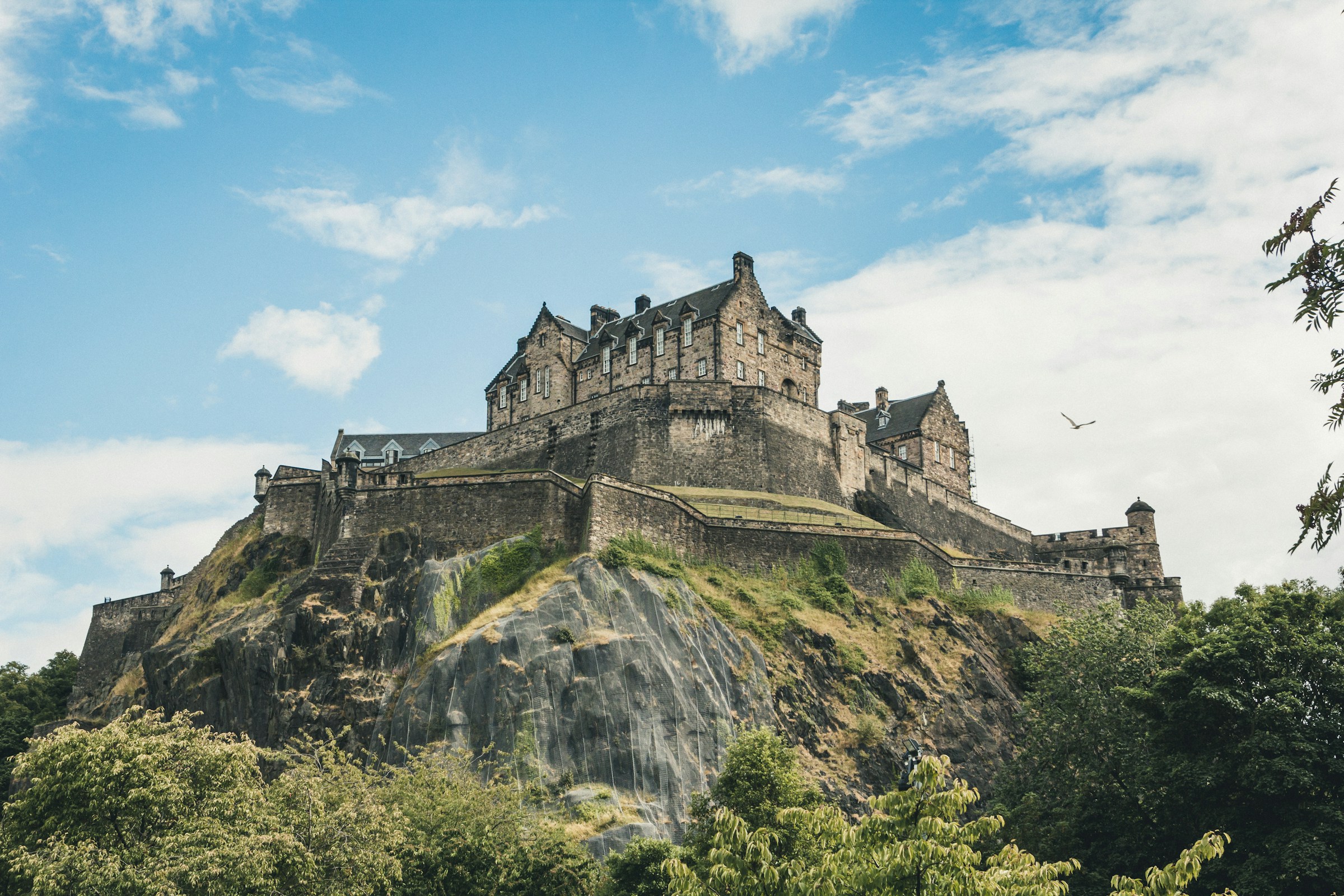
Edinburgh as a corporate conference destination: what you need to know
Edinburgh is consistently underused by corporate event buyers, particularly those based in London or the south of England. The assumption that it is difficult to get to or expensive to host in does not match reality. This is what the city actually offers for corporate conference and meeting programmes.
Why Edinburgh works
Edinburgh is accessible from every major UK airport, with direct flights typically under two hours. The city centre is compact and walkable, which matters for multi-day programmes where delegates are moving between sessions, restaurants and hotel. Scotland's devolved calendar also means Edinburgh has fewer competing national events clogging venue availability during autumn, which is the peak season for the rest of the UK.
The venue landscape
The city has a strong cluster of conference hotels, most within a 10-minute walk of Waverley Station. For larger conferences, the Edinburgh International Conference Centre handles up to 1,200 delegates with strong AV infrastructure. For smaller leadership events or boardroom dinners, the city's Georgian townhouses and private dining rooms offer something that standard conference hotels cannot. The variety between a castle hire, a converted bank and a contemporary hotel is wider than most cities of comparable size.
Venues worth knowing
A selection of properties we would put on an Edinburgh shortlist for corporate programmes.
The Hoxton, Edinburgh
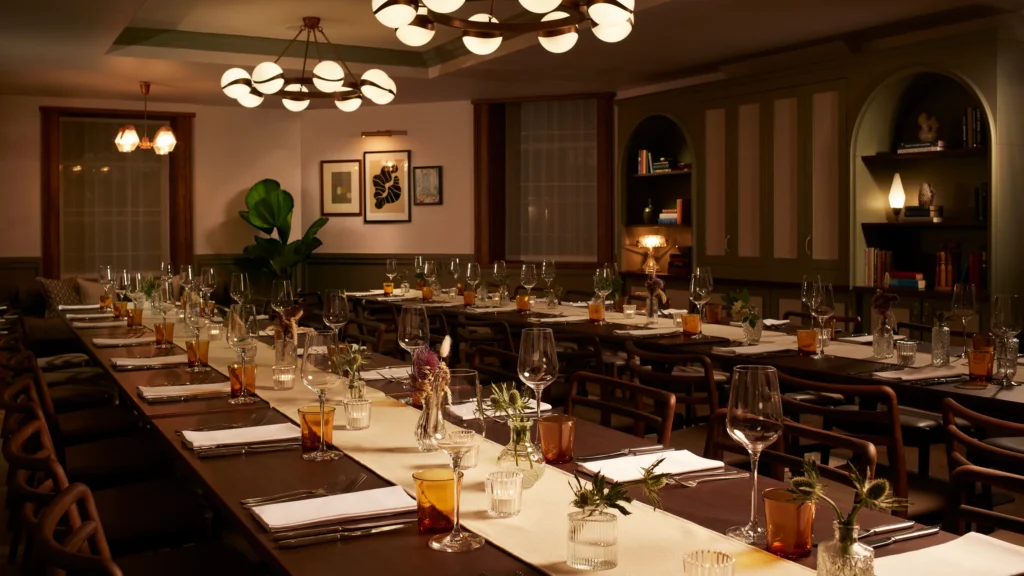
A design-led boutique hotel in the city centre, The Hoxton suits medium executive groups, off-sites and away-days where the standard conference hotel feel is not right. Strong F&B programme and a relaxed atmosphere that works well for creative and professional services clients. Good for groups of up to 60 to 100.
"What I love pitching to clients is that we take the meeting seriously, but never take ourselves too seriously. Great coffee, great energy, zero corporate stuffiness. We are the perfect fit for clients looking for something a bit fun and funky, and with natural daylight, unlimited cuppas and packages that mean everything is taken care of, whether you are in The Apartment or The Get Together, it is an easy yes."
Kate, The Hoxton Edinburgh
Kimpton Charlotte Square, Edinburgh (5-star)
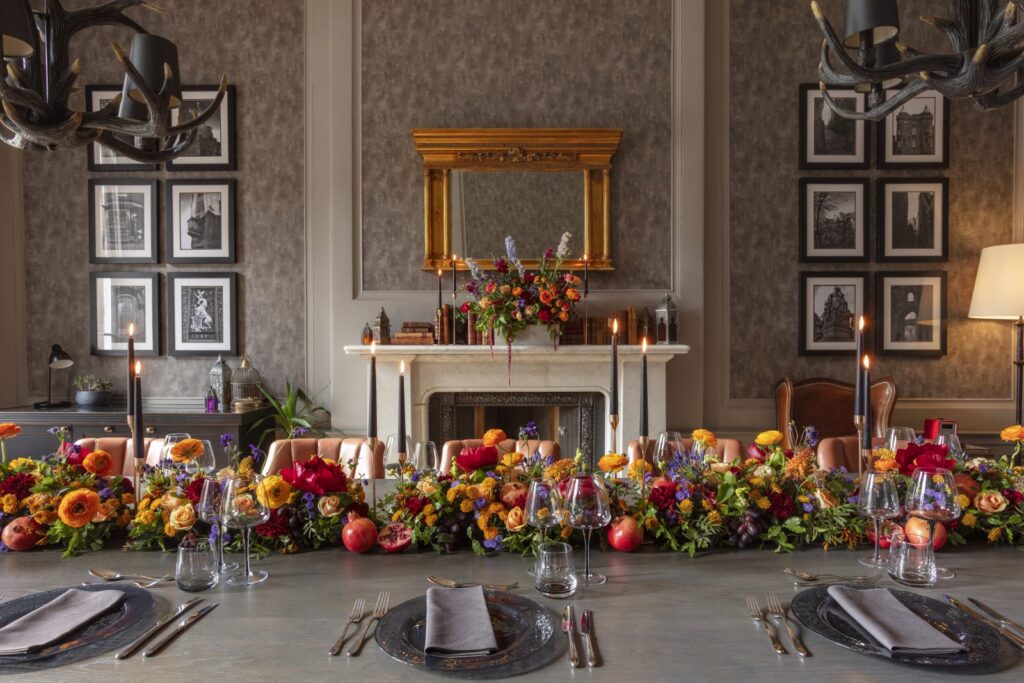
Set in a terrace of Georgian townhouses on Charlotte Square in the heart of Edinburgh's New Town, the five-star Kimpton Charlotte Square combines period architecture with contemporary interiors. With 199 bedrooms and a Gallery Ballroom accommodating up to 184 in cabaret layout, it handles residential conferences and leadership programmes at scale.
The Summerhouse inner courtyard can be privatised for smaller lunches and evening networking events. For more intimate gatherings, the Dining and Drawing Rooms overlooking Charlotte Square seat up to 20. The property has gym and spa facilities and access to the private Charlotte Square gardens, making it a strong option for programmes that want to incorporate a wellness element. The Levantine-inspired Baba restaurant adds something beyond the standard hotel dining offer.
Information courtesy of Annabel Drysdale, Kimpton Charlotte Square Edinburgh
The view from VisitScotland
"Edinburgh continues to be one of Scotland's leading destinations for MICE, combining excellent connectivity with a rich blend of history, culture and hospitality. As Scotland's capital city, it offers delegates easy access via its international airport and city centre train stations, alongside an impressive range of luxury hotels, conference facilities and unique venues that cater to events of every scale and budget."
Theresa Steven, VisitScotland
What to watch for
Hotel supply in Edinburgh tightens significantly during Festival season (August) and over Hogmanay. For corporate conference programmes, September through November is the sweet spot: venue availability is good, the city is quieter, and rates are more competitive than London equivalents. The better-regarded conference hotels in Edinburgh hold provisionals early, and autumn dates go faster than buyers from outside Scotland often expect.
Transport and logistics
Most delegates from London will fly. Edinburgh Airport is around 20 minutes from the city centre by cab, or reachable by tram in around 35 minutes. Direct trains from London Kings Cross to Edinburgh Waverley take 4 hours 20 minutes and are a genuine option for smaller groups or those travelling from the north of England. Internal transport within the city is straightforward. For a two or three-day residential programme, the compact geography is an asset.
Shortlist these Edinburgh venues
If Edinburgh is not on your shortlist for autumn 2026 or 2027, it is worth a look. We work with a range of Edinburgh properties across hotel, venue and private dining categories and can put together options quickly once we have a brief. Get in touch.

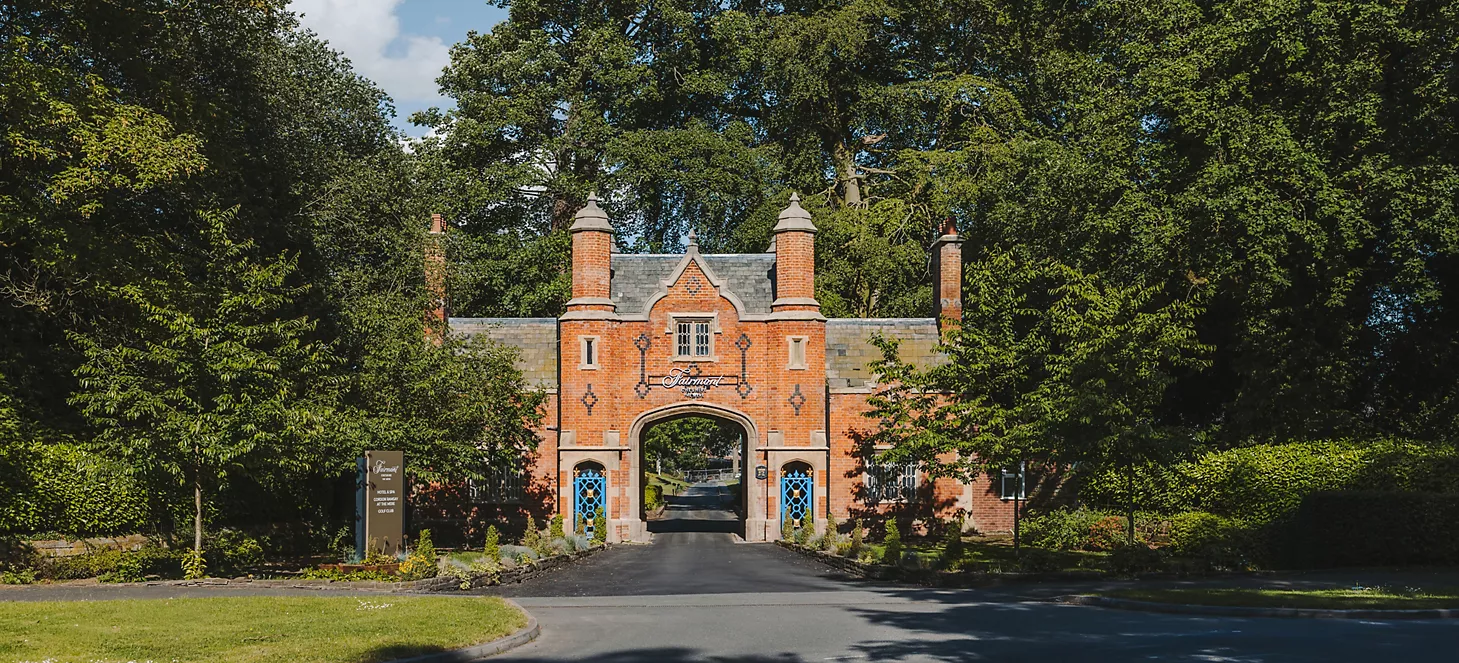
Fairmont Cheshire, The Mere opens this July on our doorstep
The lakeside Cheshire estate has been reborn as Fairmont Cheshire, The Mere. Opening July 2026, it brings 116 rooms, Gordon Ramsay at The Mere, a championship golf course and a new Fairmont Spa to 157 acres of parkland near Knutsford.
The Mere has been a fixture of the Cheshire landscape for years. From this July it reopens under the Fairmont name following an extensive restoration, and for event organisers in the North West it lands as one of the most complete venues in the region: a resort, a spa, a championship course and a serious restaurant, all within half an hour of Manchester.
The setting does much of the work. The estate sits on 157 acres of parkland beside The Mere lake, reached through its original gatehouse. The restoration takes the room count to 116, including 27 suites, finished in a calm, contemporary style that lets the lakeside views lead.
"The Mere has always been a strong option for our North West clients, and the Fairmont restoration has lifted it into a different bracket. A championship course, a Gordon Ramsay restaurant and a proper spa on one estate, 30 minutes from Manchester, is a rare combination."
Alex Barlow, Head of Operations & Strategy, Bien Venue
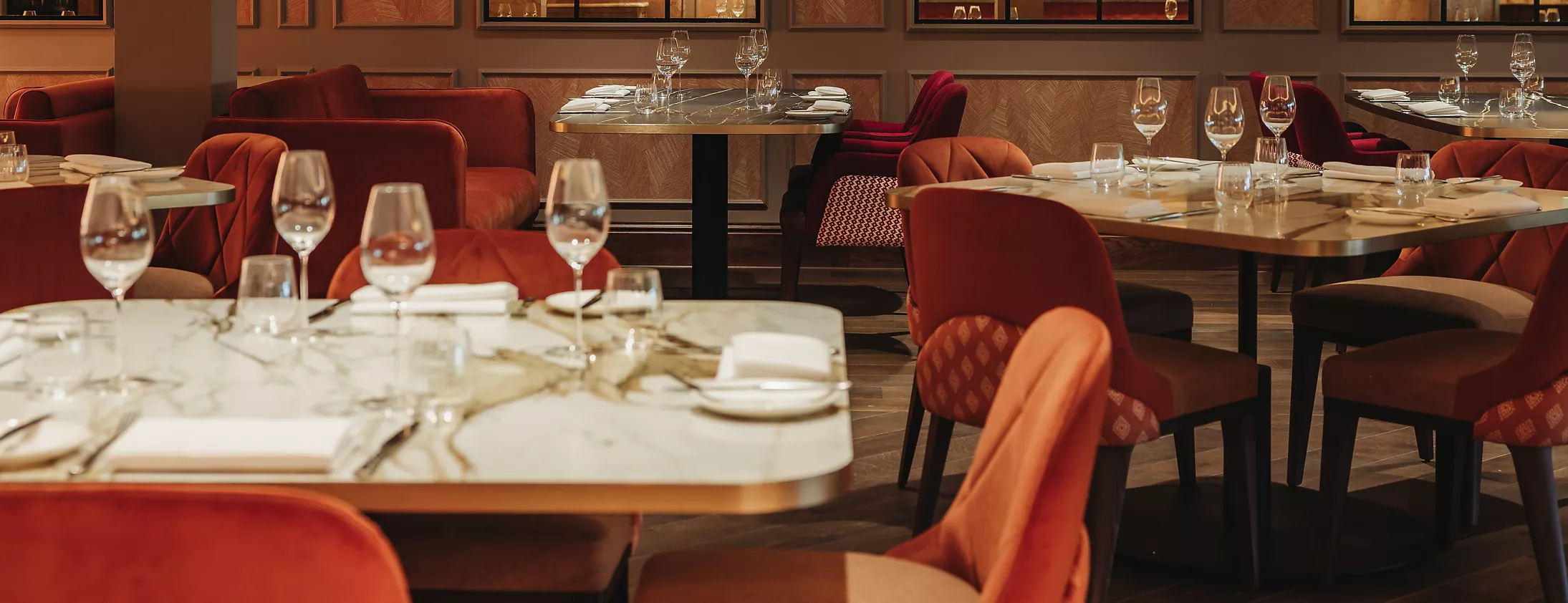
Dining is the headline. Gordon Ramsay at The Mere anchors the food offer with British and French-inspired cooking, supported by a collection of restaurants and bars across the estate, from an all-day garden room under a glass roof to a lakeside bar built for a long evening. The James Braid and Nick Faldo championship course remains, 18 holes of rolling Cheshire greens and lakeside vistas, with a driving range and lessons on site.
For wellbeing and downtime, the new Fairmont Spa offers six treatment suites and a 20-metre pool. Add the ballrooms and outdoor spaces that overlook the water, and the estate covers conferences, incentives, golf days, private dinners and celebrations without leaving the grounds.
Fairmont Cheshire, The Mere opens in July 2026. For organisers planning North West events and incentives, it is one to get on the radar now.
Enquire about Fairmont Cheshire, The Mere
Waldorf Astoria London – Admiralty Arch opens this autumn on The Mall
One of London's most recognisable landmarks becomes a hotel for the first time. Waldorf Astoria London – Admiralty Arch opens in autumn 2026, with 114 rooms and suites, two restaurants holding eight Michelin stars between their chefs, and a ballroom built for occasions.
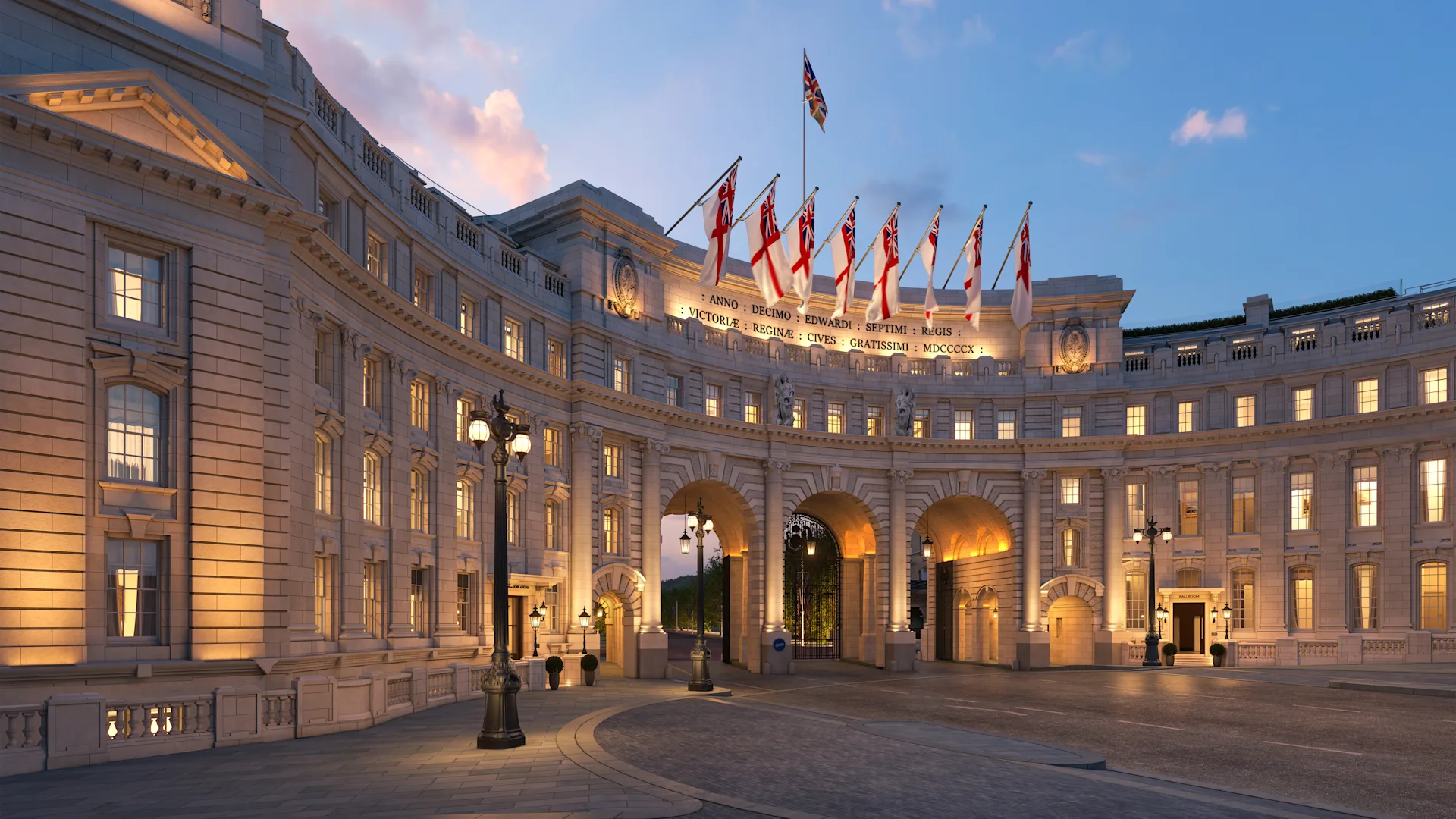
The Grade I listed arch that frames the view down The Mall towards Buckingham Palace has stood since 1912. From this autumn it opens its doors as a hotel for the first time in its history, following an extensive restoration of the Edwardian monument in St James's. For corporate event organisers, it adds a genuinely rare address to the London map.
Admiralty Arch has spent most of its life as government offices, closed to the public. The restoration, led by the Reuben Brothers, has turned the building into 114 rooms and suites alongside a collection of private residences. More than half of the accommodation is given over to expansive signature and residential suites, several named for the building's naval heritage, including the Nelson Suite, the St James's Residence and the Victory Residence, the last a nod to HMS Victory.
"New openings of this calibre do not come along often in central London, and a Grade I listed landmark on The Mall is about as rare as it gets. We are already fielding interest from clients who want to be among the first to use the event spaces." Alex Barlow, Head of Operations & Strategy, Bien Venue
The event spaces are the headline for the corporate market. A ballroom of 3,540 square feet sits beneath a nine-metre antique Murano chandelier, restored in Rome, and is flanked by a range of smaller, more intimate rooms. The brief is broad: gala dinners, conferences, weddings and brand activations, all behind one of the most photographed facades in the country.
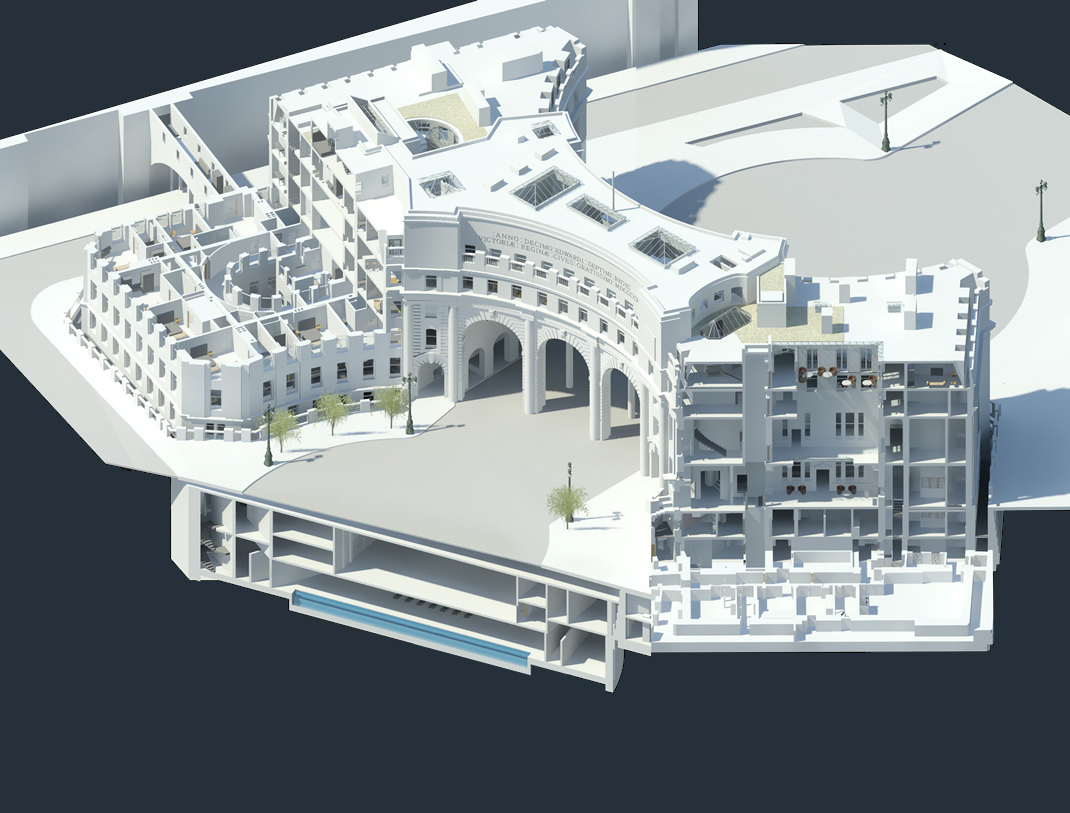
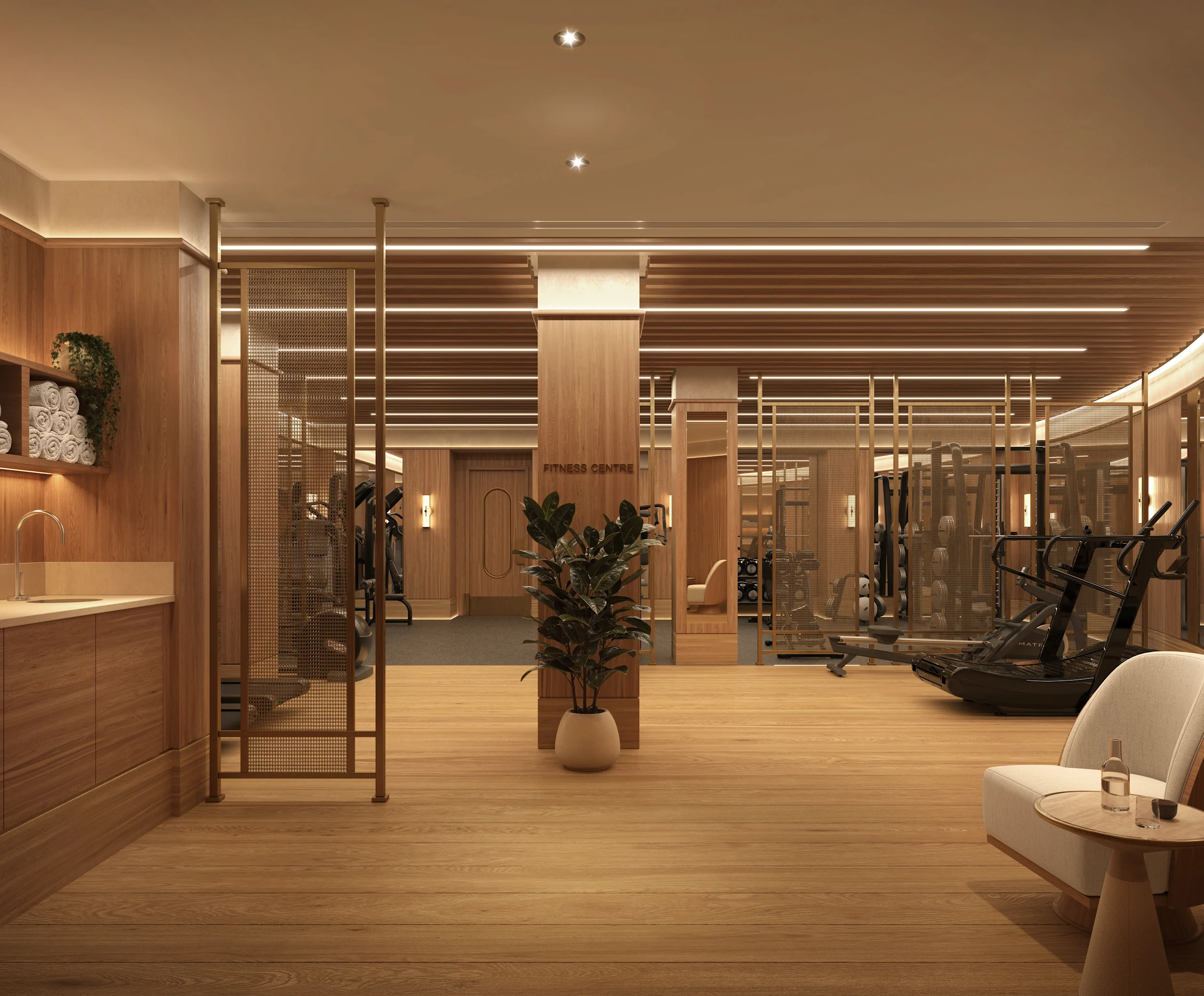
Dining will draw its own crowd. Clare Smyth MBE opens Coreus in the former home of the First Sea Lord, a fine dining room built around sustainably sourced seafood and British produce. Daniel Boulud returns to London with Café Boulud, an all-day restaurant on the rooftop with a south-facing terrace and views down The Mall. Between them the two chefs hold eight Michelin stars. A private spa with treatment rooms, sauna, steam room and hydrotherapy pool offers a quieter counterpoint to the grand public rooms.
Reservations are open now for stays from 1 March 2027, with earlier availability expected to be announced as the hotel approaches its autumn debut. We will be tracking it closely as it comes online.
For organisers planning London events into 2027 and beyond, Admiralty Arch is one to have on the radar early. Talk to the Bien Venue team about availability and site visits as they open up through bvevents.co.uk.
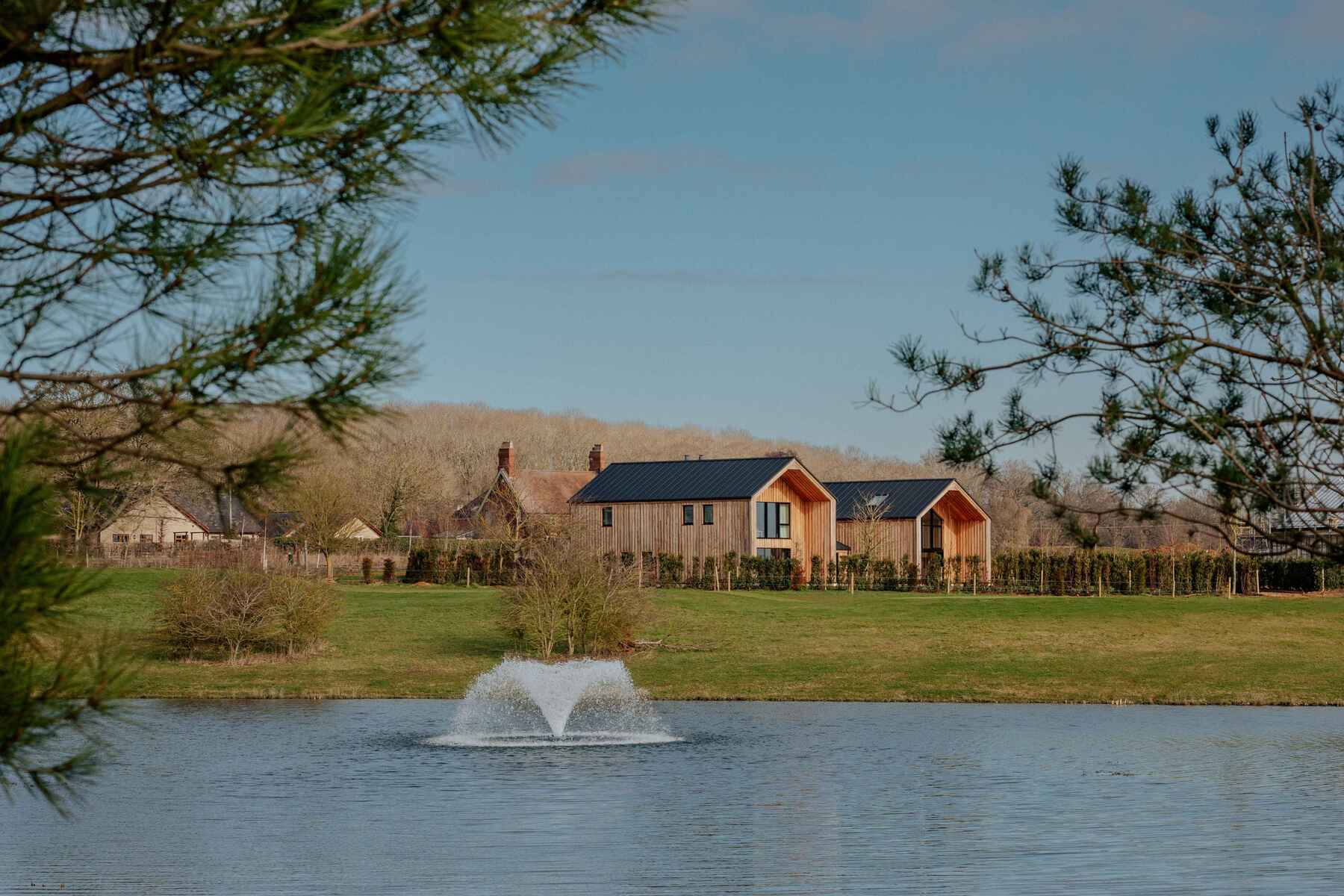
Nobu Woolfox: a luxury countryside concept arrives in the East Midlands
Nobu has confirmed its first countryside hotel, partnering with the existing Woolfox members' club in Rutland to develop Nobu Woolfox: a hotel, signature restaurant and branded residences set across 185 acres near Stamford.
Nobu announced on 6 May 2026 that it will rebrand and redevelop Woolfox, the wellness-led members' club founded in 2020 and set in 185 acres of Rutland countryside near the Georgian town of Stamford. The site will reopen as Nobu Woolfox, a destination and members club that combines lake-view rooms and suites, a signature Nobu restaurant and bar, branded residences, a spa, and dedicated wellness and leisure facilities. No opening date has yet been confirmed.
This is the first time Nobu has placed its brand outside an urban or coastal setting. The group is concurrently developing a £360m mixed-use scheme in Manchester, also comprising a Nobu hotel, a Nobu restaurant and Nobu-branded residences, and the contrast between the two projects is the point. Where Manchester is a city-centre statement aimed at the corporate and leisure traveller, Woolfox is positioned as a rural retreat: a property defined by quiet, landscape and members-club intimacy rather than skyline.
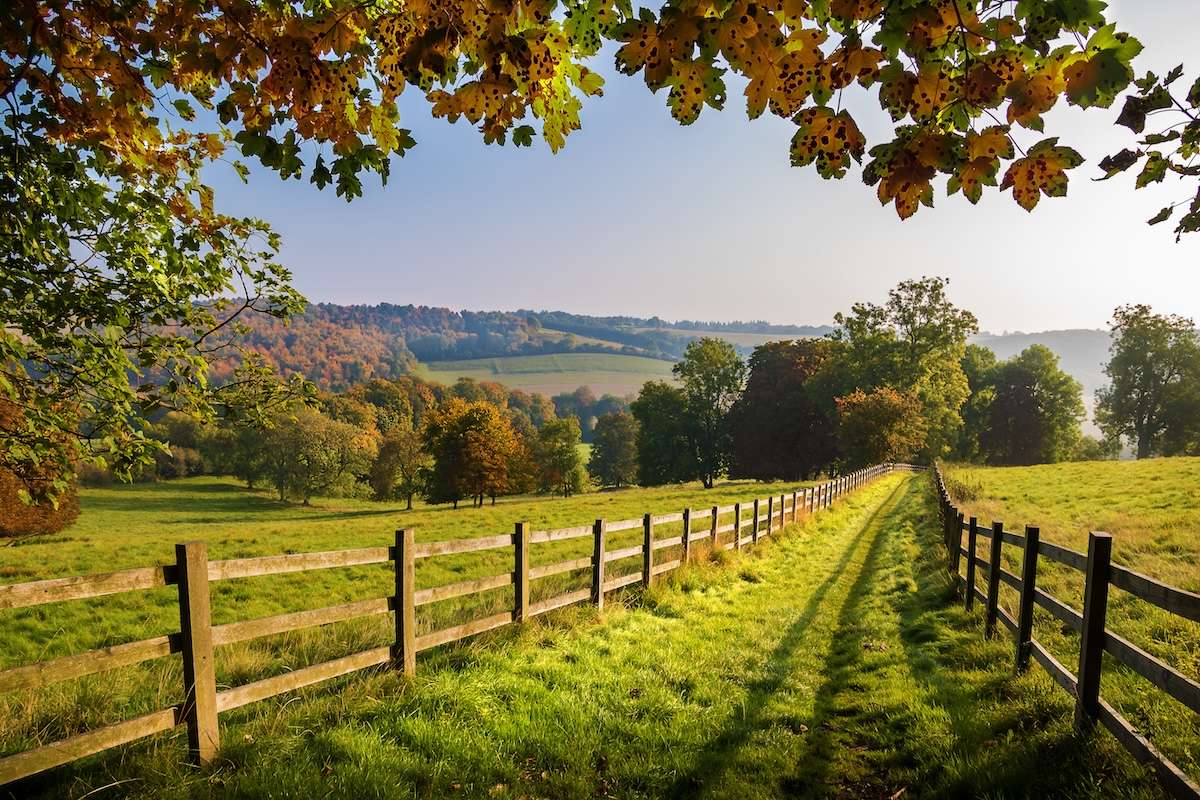
Rutland is the kind of location corporate event organisers tend to overlook because it doesn't fit the usual list. Nobu placing its first countryside property here changes that calculation. A signature Nobu restaurant, branded residences and a private members club in 185 acres, all within a comfortable drive of London, the Midlands and the North, is a meaningful addition to the UK's leadership-event landscape. Alex Barlow, Head of Operations & Strategy, Bien Venue
For corporate event buyers, the appeal sits in three places. The setting itself, with 185 acres of landscaped grounds, a lake and adjacent walking country, supports the kind of leadership offsite or executive retreat that doesn't work in a city-centre property. The branded residences open up a private-buyout proposition for board-level programmes that need accommodation, dining and meeting space under one ownership. And the Nobu restaurant gives an evening anchor that works as a closing dinner without needing to leave site. Pair that with the existing Woolfox wellness programming and the property covers the full executive-retreat brief in a single estate.
The wider context matters too. Nobu has spent the past five years pushing into the UK with the Portman Square London property, Nobu Shoreditch, the Manchester development, and now Rutland, signalling a deliberate move beyond gateway cities. For agencies sourcing premium UK venues, the practical effect is a wider geographic footprint of properties that share a recognisable service standard.
Nobu Woolfox has not announced a relaunch date. Corporate event organisers looking at premium countryside venues for 2026 and 2027 programmes can enquire through bvevents.co.uk.
About Bien Venue
Bien Venue is a Manchester-based boutique venue finding, event management and accommodation agency. We help corporate event organisers source and manage venues across the UK and internationally, supported by our proprietary BV Portal and Venue Directory.
Bring us your brief.
The properties we write about are the kind of venues we place clients at every week. If you're sourcing for a similar event, send the requirements through and we'll come back with a shortlist that fits the brief, not a directory dump.
Free to use. No account needed. Curated shortlists prepared by consultants, not a search algorithm.
Global Conferences 2026 - Where the Smart Money Is Going
2026 is seeing in-person events rebound strongly, with hotspots in tech, finance, healthcare and sustainability drawing the largest corporate sponsorships. Tech shows like CES (Las Vegas, 148,000 attendees) and MWC (Barcelona, ~85,000 attendees) remain marquee venues for product launches, while Web Summit (Lisbon, ~71,000) convenes the startup community. Major finance gatherings (Davos WEF Jan 19–23, Sibos banking forum Sept 28–Oct 1) and health/pharma events (JPMorgan Healthcare Jan 12–15, BIO International June 22–25, HLTH Las Vegas Nov 15–18) will attract heavy investment dollars. Web3 conferences are shifting away from San Francisco to Miami and Asia (Consensus Miami May 5–7, Consensus Hong Kong Feb 10–12, Ethereum’s EthCC Mar 30–Apr 2), reflecting global interest in crypto and blockchain. Across sectors, sponsors are prioritising events with high-quality, targeted audiences and hybrid reach. Polls indicate that tech, finance, healthcare and ESG/sustainability-related shows command the lion’s share of sponsorship budgets. Newer markets (APAC, Middle East, Africa) are opening up: Asia-Pacific events (e.g. Consensus Hong Kong) are selling out, and large summits on sustainability or FinTech in Dubai and Africa are attracting regional investors. Event organisers should sharpen their sponsorship packages (tiered booths, virtual experiences, data-driven ROI tracking) and target the evolving priorities of corporate buyers. Table 1 (below) compares top 12 conferences by sector on attendance, costs and audience profile. Key takeaways for investors and organisers are summarised at the end.
Major 2026 Conferences by Sector
Tech (general & AI)
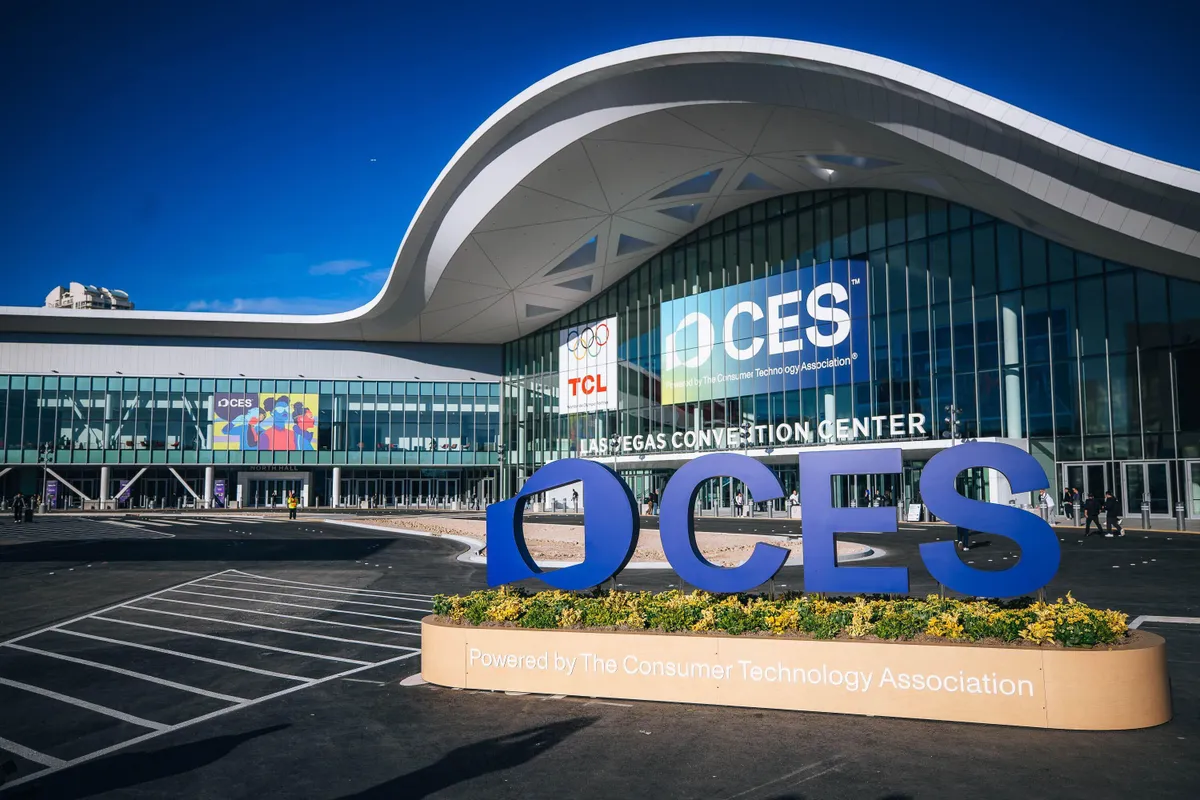
Flagship shows include CES 2026 (Las Vegas, 6–9 Jan), MWC Barcelona (27 Feb–2 Mar) and Web Summit (Lisbon, Nov). CES drew ~148,000 attendees from over 150 countries, making it the tech industry’s apex showcase of consumer electronics. MWC likewise attracts ~85,000 global mobile and enterprise tech professionals. IBM’s World Economic Forum (Davos, 19–23 Jan) blends tech with economics. Event sites report Nvidia GTC (16–19 Mar) and AWS re:Invent (late Nov) will highlight AI/cloud trends. Apple/Google developer summits (WWDC, I/O) occur mid-year. GITEX Global (Dubai, 7–11 Dec) is refocused for AI and chips (“World’s top chipmakers… AI era”). Shorter shows like Microsoft Build and smaller innovations fairs round out tech events.
Climate & Sustainability
Government-led summits dominate here. The UN Climate Change Conference (COP31) is scheduled for late 2026 (likely Antalya, Turkey), while UNCCD COP17 (land use) runs 17–28 Aug in Mongolia and CBD COP17 (biodiversity) 19–30 Oct. Private-sector sustainable business summits are rising: the World Sustainable Development Summit (New Delhi, 25–27 Feb) and Climate Week NYC (Sept 2026) engage corporates on ESG. Economist Impact’s Oceans Summit (Montreal, Mar) links sustainability with finance. Niche events like the Africa Climate Summit (Addis Ababa, 2026) indicate emerging regional interest. Overall sponsorship is tilting toward climate-tech and renewable-energy summits, though exact spend figures are scarce.
Biotech & Healthcare
The annual JP Morgan Healthcare Conference (San Francisco, 12–15 Jan) is a must-attend for biotech investors. BIO International Convention (San Diego, 22–25 Jun) is largest in biotech (10,000+ attendees). Health-tech and hospital execs convene at HLTH USA (Las Vegas, 15–18 Nov; ~12,250 attendees with 4,300+ C-levels) and HIMSS Global Conference (likely Las Vegas, Mar). These events attract pharmaceutical and medtech sponsors. Clinics & pharma vendors see high ROI through stage time and networking.
Finance & Fintech
Global banking meetings include WEF Davos (Jan) and IMF/World Bank fall meetings. Industry shows: Sibos (Miami, 28 Sept–1 Oct) is SWIFT’s fintech conference, while Money20/20 USA (Venetian LV, 18–21 Oct) serves digital payments and banking. Finovate, Fintech Festival (London/Singapore), and Paris Blockchain Week cover crypto. Traditional finance sponsorship remains robust, but heavyweight attention is shifting to AI-driven fintech and crypto (see Web3 below).
Web3 & Crypto
Traditional crypto events (Bitcoin 2026, Apr 27–29, Las Vegas; Consensus Miami, May 5–7) are re-emerging after pandemic lows. Consensus Miami’s site touts ~20,000 attendees (global crypto/institutional). Asia’s first Consensus Hong Kong (Feb 10–12) aims for 15K. Ethereum Community Conference – EthCC (Cannes, 30 Mar–2 Apr) – is EU’s largest Ethereum event (6,500+ in 2025). Emerging are niche crypto-events (NEARCon, LendIt, etc.), but sponsors heavily target the top-tier. Metrics: Consensus cites 100+ countries, “$4T AUM” of previous attendees to impress sponsors.
Meetings & Events Industry
Self-reflexive trade shows remain central. IMEX Frankfurt (19–21 May) and IMEX America (13–15 Oct; 17,000 in 2025) are leading trade fairs for event planners. IBTM World (Barcelona, 17–19 Nov) attracts ~15,000+ global MICE professionals. These run tri-fold on bookings for venues, technology providers and DMOs. (ICE Europe, IBTM, IBTM Americas) also matter regionally. Sponsors of these industry shows include CRM and travel tech firms.
Sponsorship Trends: Where the Money Flows
Sponsors are chasing high ROI and audience specificity. Technology and healthcare remain top spenders: enterprises fund AI/tech events (CES, AWS) to showcase innovation, pharmaceutical companies flood health summits (JPMorgan, BIO). Sustainability and finance themes (e.g. climate tech, ESG, crypto) are also hot. For example, global reports suggest brands see digital/entertainment sectors as key sponsorship arenas in 2025, often in combination with AI or Web3 branding (SportBusiness, SponsorUnited). In conferences, anecdotal data indicate platinum sponsorship packages (large booths, keynotes) can run into six figures. Organisers report that adding hybrid formats and on-demand content lifts total sponsor revenue by ~30% over pure physical events. A TicketFairy analysis notes one trade show’s hybrid edition yielded a 30% jump in sponsorship revenue when virtual booths were sold alongside live booths. Many events now bundle “digital booth + live expo” at premium cost.
Another trend is tiered ticketing: offerings range from basic passes (<£100–£300) to VIP “executive” or “whale” packages. For instance, a leading crypto conference in Las Vegas sells “Whale Pass” at $9,499 (all-access VIP), far above general admission. Tech events similarly price premium “innovator” or “investor” passes higher. Sponsors can purchase naming rights to tracks or lounges (e.g. HSBC stage at Web Summit). Smaller niche summits now sometimes offer equity stakes or revenue-sharing instead of flat fees, mirroring startup fundraising structures.
Regions matter: Asia-Pacific is drawing new sponsor budgets. Consensus Hong Kong’s organisers tout “15K attendees from 100+ countries” and a $4T AUM behind them, highlighting Asia’s prize. In the Middle East, Gulf Expo’s (e.g. GITEX Global Dec 7–11) attract multinational tech advertisers keen on the MENA market. Africa’s growth was signalled by the Abuja Work Programme and planned Africa Climate Summit, though Western dollars are still smaller. Virtually, organisers sell geo-targeted digital ads (e.g. limiting streams to APAC time zones for Asia-based sponsors).
On formats, hybrid is now standard. Surveys show ~86% of organisations see positive ROI from hybrid events. Smart sponsors demand data metrics: time-spent, click-throughs, lead capture, etc. Virtual sponsorships (branded streams, virtual lounges) have become an explicit line item in budgets. One case study noted an electronics sponsor underwriting an entire concert stream in exchange for branding, covering the organiser’s costs. These digital plays mean sponsor evaluation now accounts for both physical footfall and online impressions (often double-counted via on-demand replay sales).
Understanding Attendees and Sponsor Buyer Personas
Event sponsors think in terms of buyer personas. A corporate sponsor typically seeks: 1) Brand exposure to decision-makers, 2) Lead generation among specific demographics (e.g. CIOs, C-suite, investors), 3) Thought leadership (speaking slots), 4) Networking (B2B deals). For example, HLTH USA reports 12,250+ attendees with over 4,300 C-suite executives – demographics i.e. hospitals CEOs, health-tech investors and policy makers. A medtech company at HLTH can reach 70+% of Fortune 100 hospital systems. Similarly, MWC’s audience is about 60–70% corporate/enterprise (CTOs, network architects), so telco and network vendors target those.
Sponsor ROI is often gauged in media and mindshare. Major conferences tout “earned media impressions” as a return: CES, for instance, claims thousands of press coverage stories. Others look at deal volume: Consensus records number of VC pitches or M&A meetings that occurred. Private briefings with sponsors show many judges scale ROI by how many C-level meetings they booked (often via a conference’s concierge). In price bands, sponsors note that mid-tier packages (Gold/Silver) often convert to renewals only if they hit lead targets; failure to meet lead quotas (tracked via attendee badge scans) can sour deals.
In summary, attendees are top-level professionals and niche enthusiasts, not casual masses. CES’s attendee breakdown is 27% international, heavy on media & tech executives. MWC draws CTOs and biz-dev teams with ready budgets for connectivity. Healthcare events pull physicians and pharma VPs, while Web3 events pull crypto-fund managers and blockchain developers. Planners now prepare persona decks (e.g. “health insurance exec” or “CISO for finance”) for sponsors. The most lucrative tickets are premium packages aimed at the highest tiers (e.g. bankers, government officials).
Emerging Regions and Niche Opportunities
Investors should scan beyond the usual US/EU markets. Asia is surging: beyond Consensus Hong Kong, events like Vue.jsConf (Tokyo), DevOpsDays (Seoul) and FinTechFestival Singapore see increased sponsor interest. The Middle East is a new frontier: Dubai FinTech Summit, GITEX Global and COP28 (UAE 2023) showed that Gulf countries want to brand as innovation hubs. Dubai World Energy Forum and Arab Health (Dubai) draw global companies. Africa is nascent: Kenya’s Nairobi Innovation Week and Accra Tech Week are small but growing; a NATO-allied climate summit (ACS2 in Addis, 2025) signals high-level focus though private sponsorships are still limited.
Even niche sectors are specialising: Clean energy trade shows (Dubai Sustainability Week), SpaceTech expos, Global HR tech, AgriTech summits (Bangkok), and eSports conventions (Hong Kong/Germany) have sponsors in millennial markets. Virtual communities (e.g. blockchain Discord groups) occasionally spin up their own online “summits” with sponsor funding (like virtual sponsor lounges at Decentralised conferences).
Risks, Headwinds and Geopolitical Factors
Conference investment isn’t without risks. Economic headwinds (inflation, travel costs, corporate belt-tightening) mean budgets are scrutinised. High venue costs have pushed sponsors to demand measurable ROI; some shows saw late cancellations in early 2025. Pandemic legacy: Organisers note the challenge of keeping virtual platforms up to date – a poor streaming experience can tarnish brand ROI. Geopolitical tensions loom: e.g. visa policies (after Brexit, Huawei bans), travel embargoes, sanctions (e.g. Russia/Ukraine) can hobble attendance or sponsorships. The WEF Davos 2026 notably grappled with delegate travel warnings amid global unrest. Export controls on tech (AI chips) might dampen North-South sponsor flows for some events.
Regulation is key: Crypto conferences worry about sudden rule changes (as happened with US regulations on stablecoins), while health events must track compliance (FDA, CE marking topics). Some regions (EU) may impose digital-content taxes that affect sponsored streaming. Climate change risks itself are influencing scheduling: monsoon season events in Asia, or extreme weather delaying outdoor tech summits.
Emerging cybersecurity threats (conference data breaches) also make sponsors cautious about event apps and Wi-Fi. On the whole, sponsors hedge by diversifying their event portfolio: if one conference falters (e.g. a virtual hackathon that never fills seats), they re-allocate spend to more proven ones. Event organisers mitigate risk by guaranteeing certain deliverables (e.g. lead counts, branding impressions) or offering partial refunds if live attendance dips below thresholds.
Actionable Takeaways for Investors and Organisers
- Consider Hybrid, But Differentiate: Combine a tight physical programme with a high-quality virtual tier. Structure distinct sponsor packages for digital experiences (e.g. branded webcast rooms). Case studies show hybrid editions can net +30% more sponsor revenue.
- Target High-Value Niches: Focus on sectors with growth (AI, Fintech, GreenTech, BioHealth) and regions hungry for investment (APAC, Middle East, Africa). Example: Consensus shifted to Miami/HK to capture institutional finance interest.
- Personas & Data: Define attendee profiles in advance. Provide sponsors with granular data (role, time-on-content, meeting schedules). Platforms that offer real attendee insights (from registration and app tracking) can charge premium rates.
- Agile Portfolio: Balance big tent-pole conferences with emerging “boutique” summits. Newer formats (hackathons, think-tanks) may yield large multiples on sponsor dollars. Pivot if an event underperforms – sponsors do not pay for ‘maybe’ impressions.
- Content & Continuity: Convert sessions into year-round assets. Offer on-demand packages or subscriptions; sponsors like the idea of long-term branding (e.g. “Powered by [Sponsor] on our 90-day replay hub”).
- Cost Controls & Guarantees: Negotiate clear deliverables. Consider dynamic pricing (delaying streaming until venue sell-out) or geo-fencing to protect in-person sales. Offer refunds or bonus exposure if certain metrics aren’t met.
- Watch Regulations: Anticipate travel bans/visa issues (e.g. offer last-minute remote sponsorship rights if in-person attendance drops). Stay abreast of compliance – e.g. data privacy for post-event lead lists.
- Engage Sponsors Early: Involve key sponsors in programme planning. Early sales allow scheduling their keynote or exclusive roundtable, increasing buy-in and ROI. A confident sponsor base can even co-invest in marketing campaigns for the event.
Finally, maintain flexibility. As one organizer put it, focusing solely on a single format or region is risky – the “smart money” follows the trends and data. By keeping strategy fluid and attendee needs first, investors and organisers can ensure their conference line-up for 2026 pays off.
Table 1. Key 2026 Conferences by Sector (dates/locations). Metrics are approximate; “–” indicates unavailable data.
| Conference (Sector) | Expected Attendance | Sponsor Cost Range | Audience Profile | ROI Indicators | Ticket Price (band) |
|---|---|---|---|---|---|
| CES 2026 (Tech) | ~148,000 | ~$50K - $500K+ | Global tech execs, innovators, media | Broad media reach, lead gen | ~$300 - $600 |
| MWC 2026 (Tech/Telecom) | ~85,000 | $30K - $300K | CIOs, CTOs, network vendors | New product deals | ~$700 (standard) |
| Web Summit 2026 (Tech) | >71,000 | $20K - $200K | Startups, investors, tech press | Startup-funding outcomes | €750 (early bird) |
| WEF Davos 2026 (Finance) | ~3,000 - 4,000 (invite-only) | ~$100K+ | World leaders, CEOs, policymakers | Policy impact, networking | (by invitation) |
| Sibos 2026 (Finance) | ~7,000 (est.) | $25K - $150K | Banking/fintech CxOs | Tech adoption deals | ~$2,000 |
| JP Morgan HC 2026 (Healthcare) | ~10,000+ (est.) | $30K - $200K | Biotech/pharma leaders, investors | M&A and partnership deals | (free/industry invite) |
| BIO 2026 (Biotech) | ~15,000 (typ.) | $30K - $250K | Biotech companies, scientists | Licensing deals, funding | $99 - $1,499 |
| HLTH 2026 (Healthcare) | 12,250+ | $20K - $150K | Hospitals, insurers, digital health | Product trials, investment | $800 - $1,500 |
| Consensus Miami 2026 (Web3) | ~20,000 | $40K - $300K | Crypto founders, VCs, regulators | Startup fund-raises | $599 - $9,499 (VIP) |
| EthCC 2026 (Web3) | ~6,500 (2025) | $10K - $100K | Ethereum devs, blockchain entrepreneurs | Developer adoption | €25 - €300 |
| GITEX Global 2026 (Tech/AI) | ~100,000 (expo scale) | $50K - $400K | MENA tech buyers, gov’t entities | Regional partnerships | AED 85 - AED 250 (approx) |
| IBTM World 2026 (Meetings) | ~15,000 | $10K - $100K | Event planners, DMOs, suppliers | Exhibitor leads, host city bids | €30 - €90 |
The Northern Umbrella Trials: Luxury Edition
There are two kinds of hotel umbrellas. The ones you open politely for the twelve metres between car and lobby, and the ones you would trust on a windswept platform in February when the rain is coming in sideways and you start questioning your life choices.
We gathered a very distinguished group from some of London’s finest hotels and took them into actual British weather. Not polite drizzle. Proper northern conditions. Wind tunnels between buildings. Station dashes. Countryside rain that soaks you out of principle.
This was serious research.
Because in hospitality, it is never just the big things. Guests remember how a ballroom felt. They also remember the pen that did not work and the umbrella that folded itself inside out in public. The small details attach themselves to the brand just as firmly as the chandelier.
Corinthia London
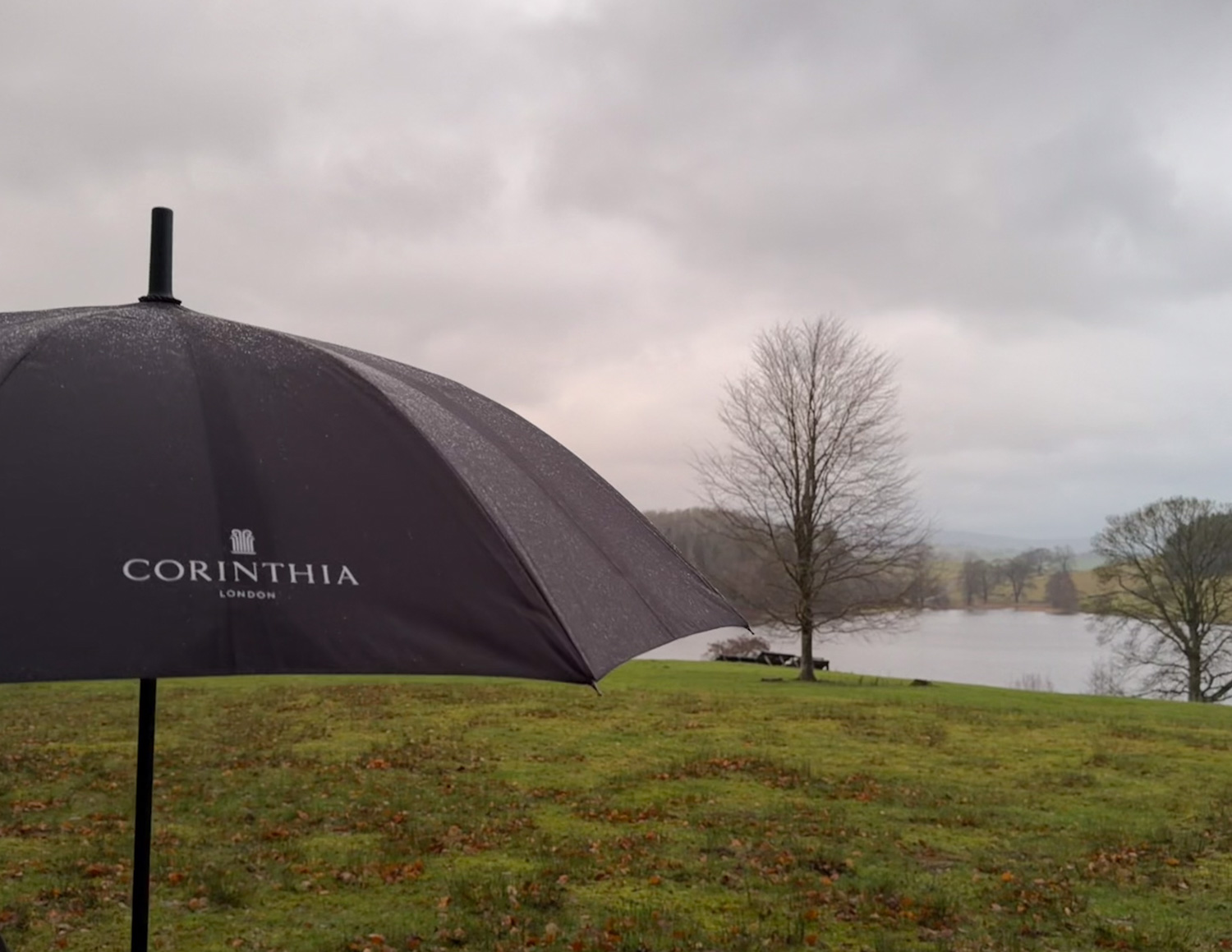
This one came to the Yorkshire Dales.
Dramatic skies, open hills, wind that does not negotiate. Exactly the sort of setting where you find out whether something is just elegant or actually capable.
Closed, it is classic and composed. Understated, balanced, with a reassuring weight. Then you look inside and realise the detailing has been thought through. It feels finished. Considered. Not a token extra.
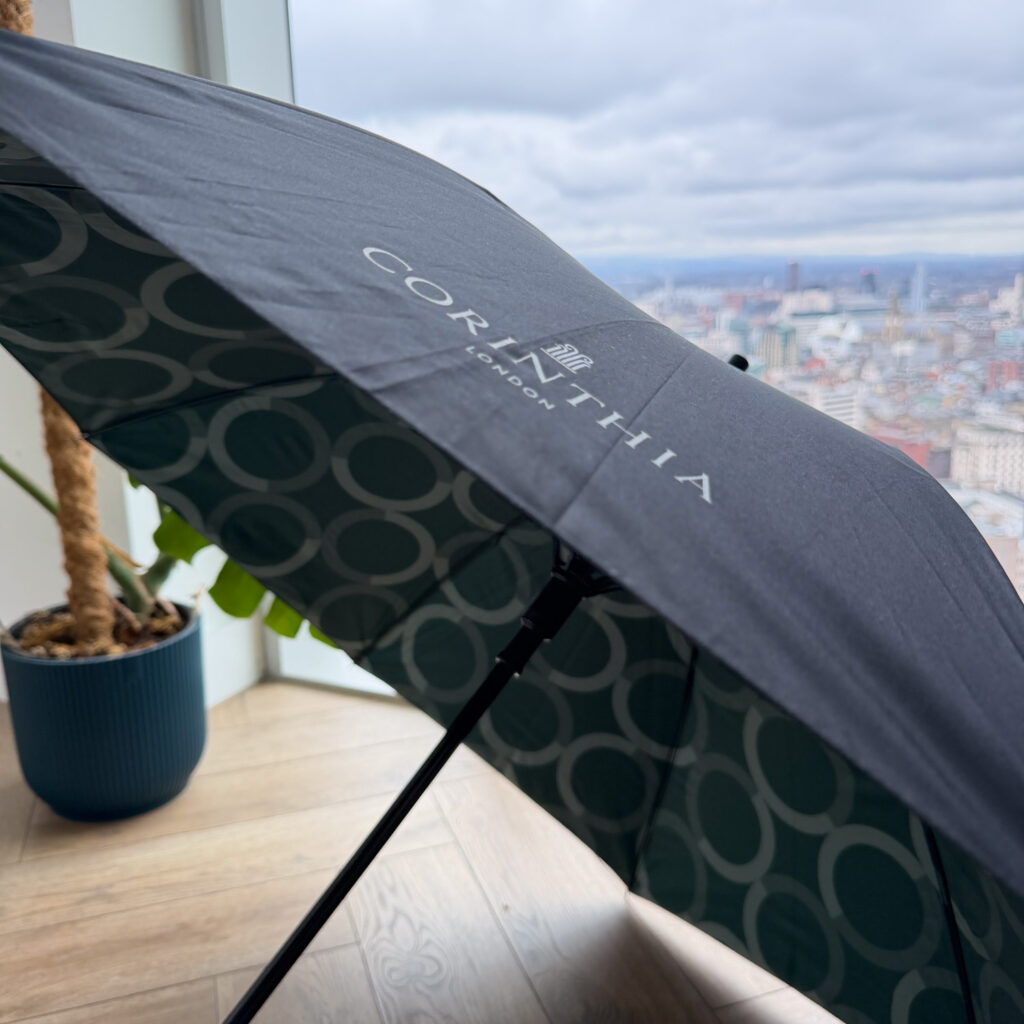
There was a moment on a ridge where the wind picked up fast enough to make me reconsider my route choices and a few life decisions. The umbrella? Mildly interested. No flip, no dramatic lurch, just a firm hold and a sort of quiet, “we’ve got this”.
Out in the Dales, it took a proper cross-field gust without flipping. I wobbled. The umbrella did not. It held its shape, its calm, and my general dignity.
Which feels very on brand. Corinthia is about polished heritage and quiet confidence. This umbrella did not shout. It simply performed.
Field note: Stood on a hill, unbothered, like it owned the weather. Energy: Refined, steady, brand consistency in umbrella form.
Hotel Café Royal
This one is the overachiever. And fully aware of it.
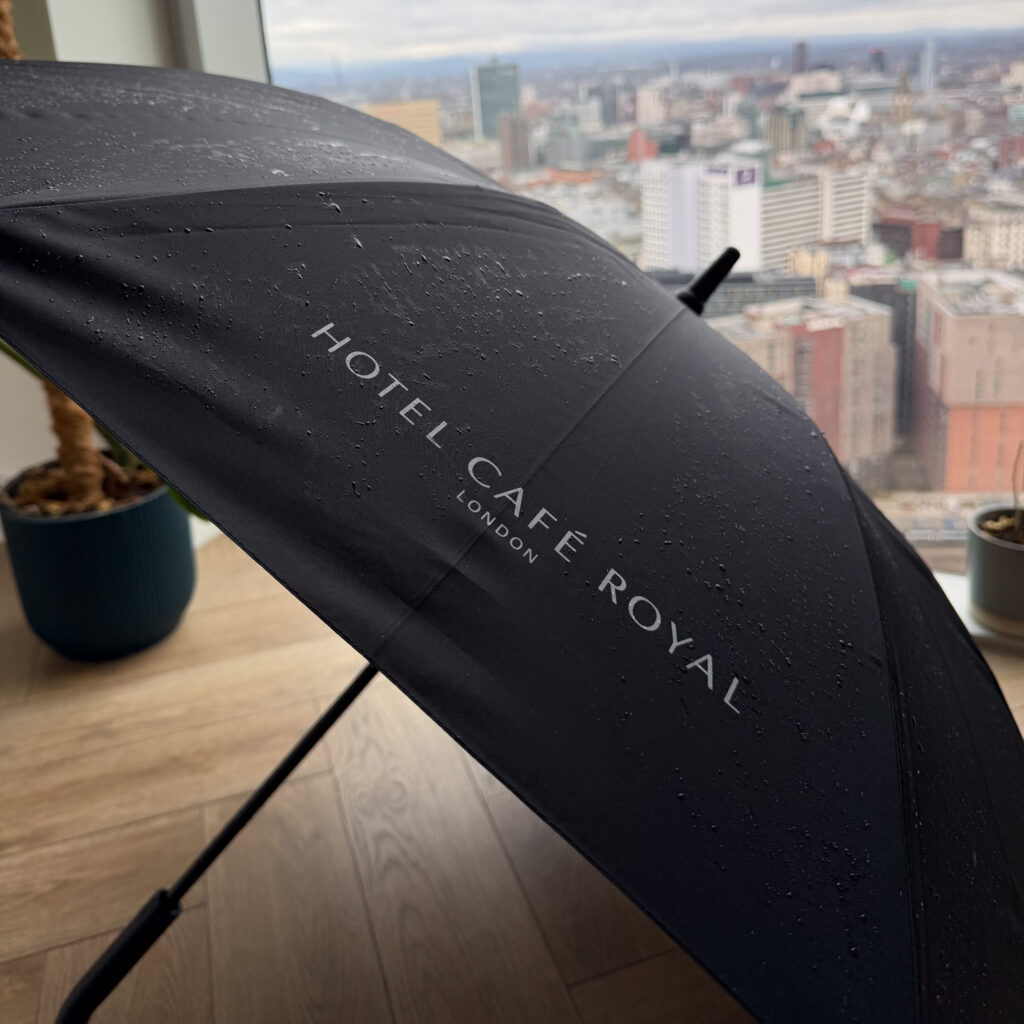
Taken into a city-centre downpour that arrived without warning, the kind where the sky moves from fine to you live here now in seconds. It opened smoothly, no wrestling, no awkward half-click, no public negotiation with the mechanism while everyone else sprints.
Then the inside.
There is design overhead. Proper design. Instead of the usual dark umbrella cave, you get detail and colour. It is a small thing, but it changes the mood when you are standing in the rain pretending you are not annoyed and absolutely are.
At one point, I was stationary under it at a crossing, rain bouncing off the road, taxis doing that aggressive city splash thing, and I realised I was weirdly calm. Not damp. Not flustered. Just… theatrically composed. That is not normal umbrella behaviour. That is hospitality energy.
In wind, it stayed calm. No rattling, no panic, no sense that it was reconsidering its life choices. The canopy held tension like it had been briefed in advance.
Café Royal is a place with history, theatre, and polish. This umbrella has that same sense of intention. It feels like someone asked, even this, how should this feel, and then actually answered the question properly.
Field note: Made a city centre downpour feel like a minor inconvenience instead of a character test. Energy: Design-led, assured, quietly excellent with main-character rain energy.
Rosewood London
This one has layers.
On the outside, it is very Rosewood. Silver, elegant, restrained. It looks refined and calm, like it belongs alongside a beautiful facade and flawless interiors.
Then you open it and suddenly brightness.
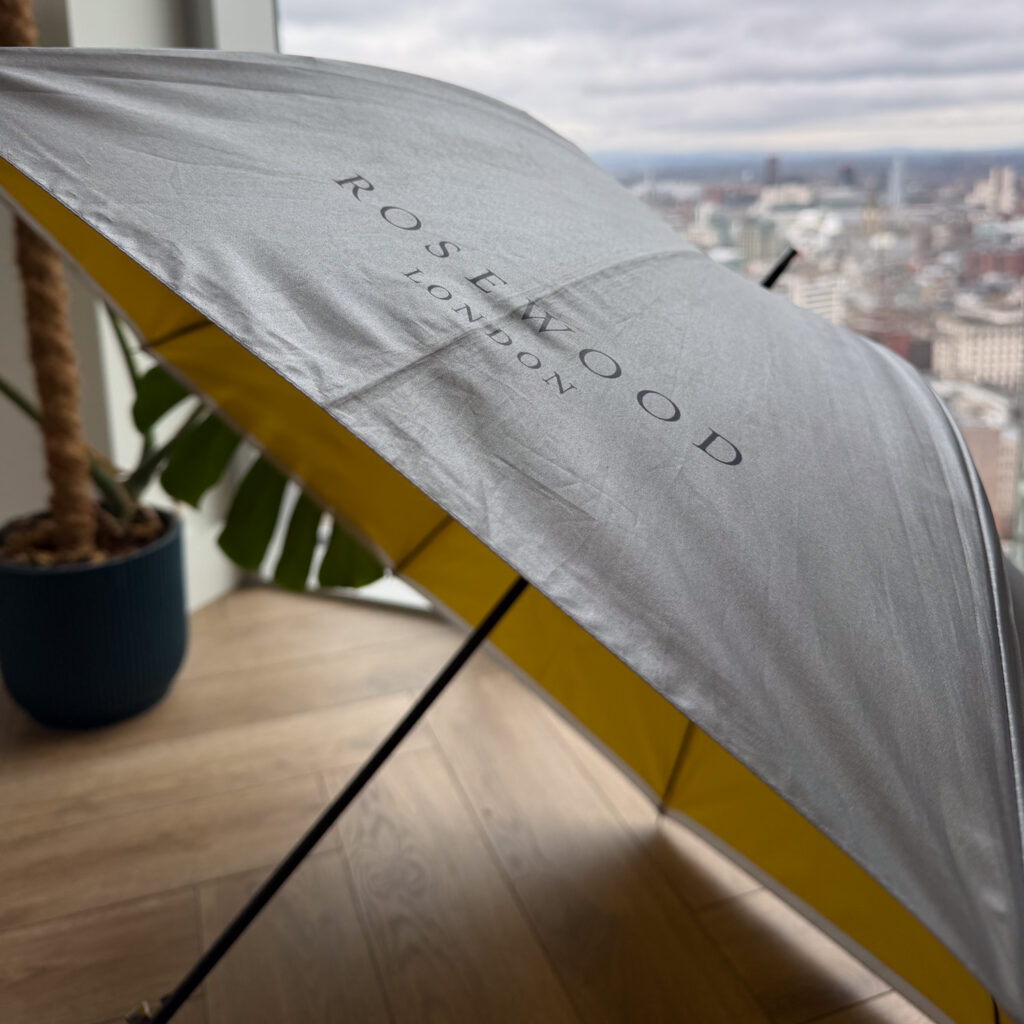
The interior is bold and uplifting. Unexpected against the subtle exterior, but undeniably effective at shifting the mood on a grey day. It is the umbrella equivalent of walking into a grand, calm lobby and then discovering a lively bar around the corner.
Used on a morning that was aggressively uninspiring, the kind of flat grey where the world looks like it needs a filter, that interior colour did more for morale than it had any right to. Low-level emotional support, delivered via canopy.
In use, it is light and comfortable, easy to carry, easy to deploy. It does the job. It just does it with more personality overhead than you might first expect.
And that is the point. A brand is not only what it looks like at a glance. It is how it makes you feel once you are inside the experience.
Field note: Turned a bleak morning into something slightly more optimistic. Energy: Elegant exterior, lively interior, memorable contrast.
The Londoner
This one saw the Lake District.
Open water, exposed paths, wind that has travelled a long way just to find you. Not forgiving conditions.
It feels built. Slightly weightier, structured, with detailing that feels deliberate rather than decorative. In a lakeside gust that definitely had plans, this umbrella did not wobble or threaten rebellion.
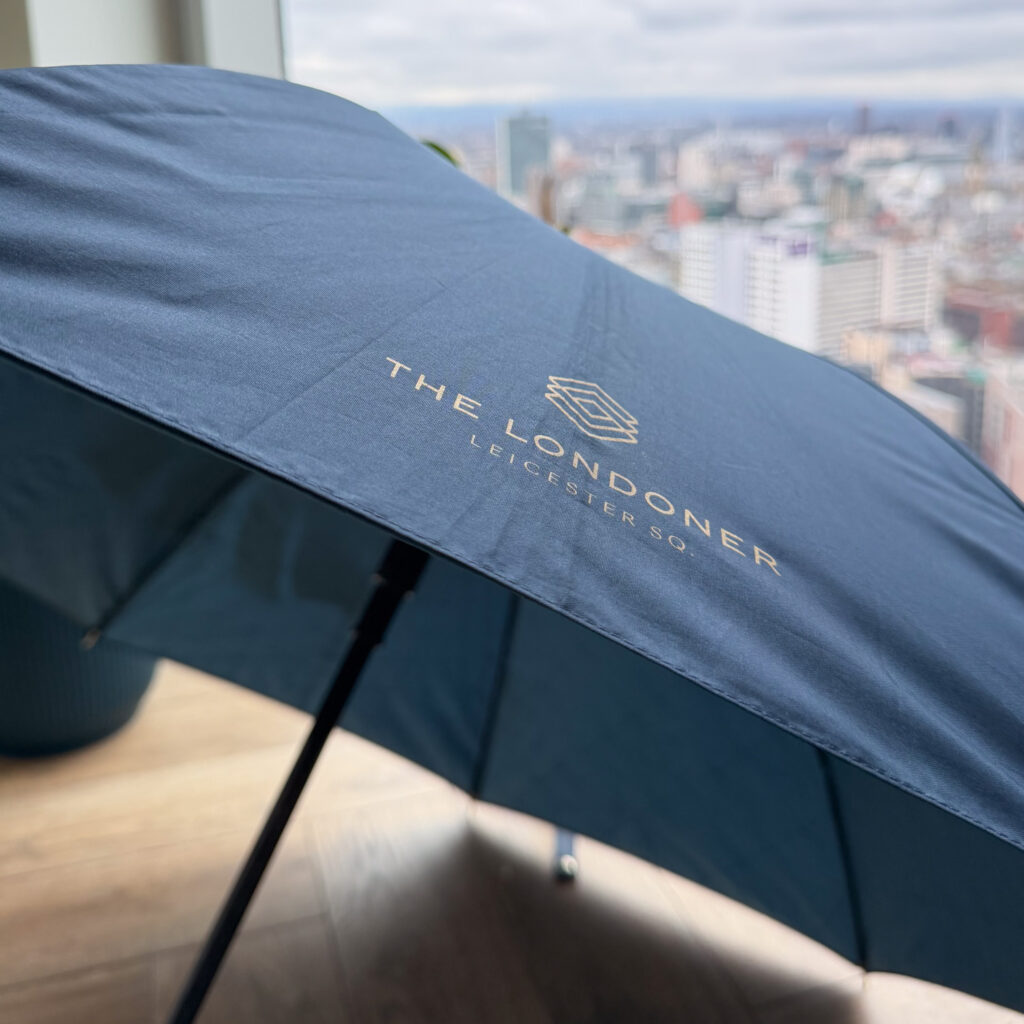
There was a stretch along the water where the wind came in sideways and committed to it. The sort that usually results in at least one dramatic umbrella failure somewhere in your peripheral vision. Not here. Structural integrity remained intact. Pride also largely intact.
It held its shape and gave that reassuring feeling of proper construction rather than optimistic fabric.
The Londoner as a brand is modern, confident, engineered for experience at scale. This umbrella feels the same. Considered. Structured. Ready.
Field note: Faced open-water wind and did not flinch. I did. Energy: Engineered, composed, built for real-world use.
Raffles London at the OWO
This is the gentleman of the group.
Also possibly the largest. This umbrella does not just cover you. It covers you, your bag, and could realistically accommodate a small family of four if everyone stands close and behaves.
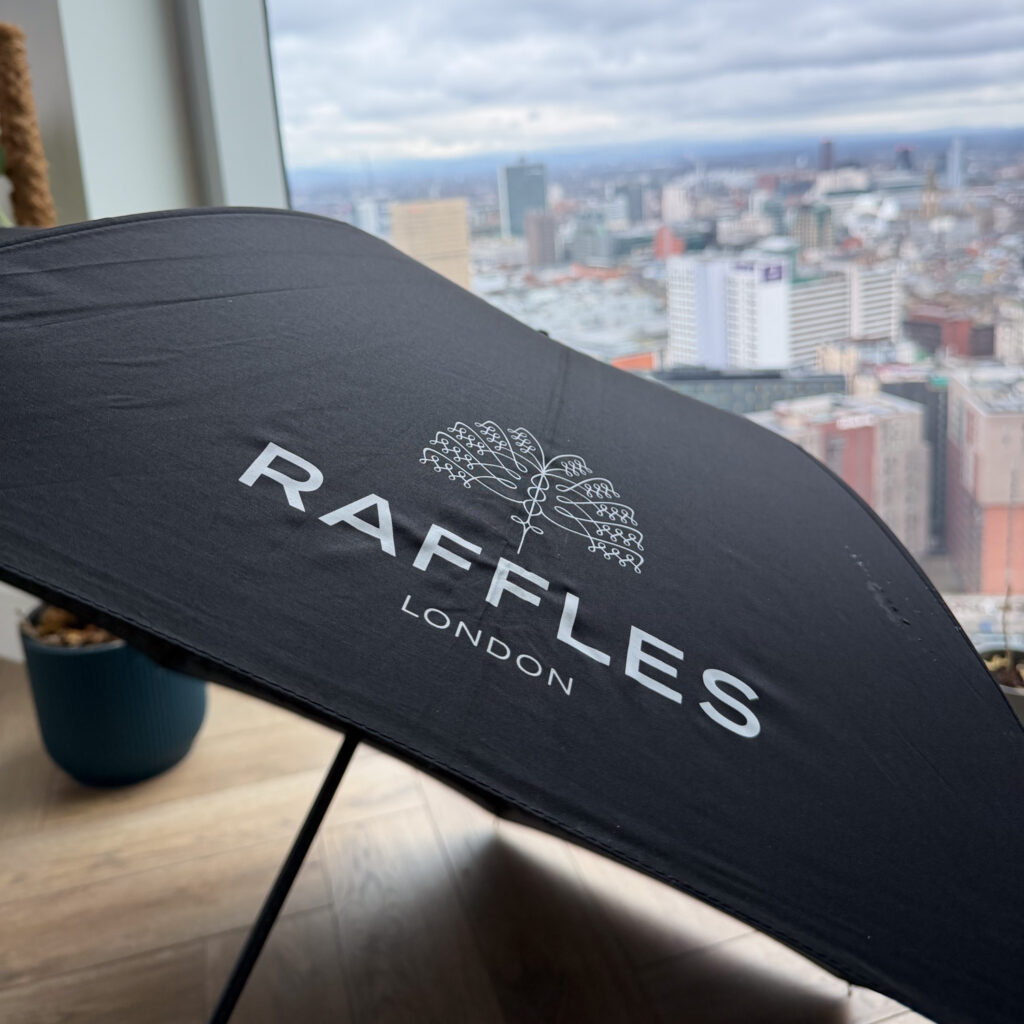
It also came to the Yorkshire Dales and created what can only be described as a mobile dry zone. Civilised. Controlled. Almost architectural.
At one point I stopped walking purely to observe the coverage radius. Other umbrellas nearby were operating in what can only be described as “hope”. This one was operating in certainty. There is a difference.
Then you look up at the inside of the canopy and realise this is not just fabric. The interior pattern is Morse code. A quiet nod to the building’s history and its intelligence roots, hidden in plain sight above your head while you are just trying not to get soaked. It reads like rain at first glance, tiny dashes and dots, but it is storytelling stitched into a storm shield. At that point, the competition was politely dismissed.
In strong wind and proper countryside rain, it stayed solid. No drama. No inversion attempts. Just broad, dependable coverage.
Which fits a brand rooted in heritage, service, and presence. Raffles is about gravitas and protection of the guest experience. This umbrella understood the assignment.
Field note: Could host a meeting underneath. Energy: Heritage, protective, quietly authoritative with covert-ops detailing overhead.
The Extra Bits That Actually Matter
A few additional scientific measures were taken in the field, purely in the name of journalism.
Doorway Drama Score. How gracefully does it collapse when you reach the entrance without baptising the floor and three guests? Café Royal and Corinthia were the smooth operators here. One neat movement, minimal splash radius. Raffles performed well but you do feel like you are closing a small sail.
Side-Eye Factor. The number of glances you get from strangers that suggest your umbrella looks expensive and possibly more organised than they are. Raffles and Rosewood scored high. One for presence, one for interior flair.
Bag-Juggle Compatibility. Can you manage umbrella, phone, tote bag, and mild existential crisis? The Londoner was the most “get on with it” option. Rosewood close behind for lightness.
Public Dignity Retention Rate. Most important metric. No sudden flips, no metal spokes attempting escape, no scene. All five passed. That alone puts them in the top tier of the global umbrella population.
The Northern Umbrella Verdict
No spreadsheets. No emotional manipulation. Just wind, rain and personal pride on the line.
Scored out of 10 in each category. No losers. Only different strengths under pressure.
Storm Survival (out of 10)
Raffles at the OWO – 9.9
Hotel Café Royal – 9.8
The Londoner – 9.7
Corinthia London – 9.6
Rosewood London – 9.0
Composure Under Pressure (Umbrella + Human)
Raffles – 10
Café Royal – 9.8
The Londoner – 9.6
Corinthia – 9.5
Rosewood – 9.1
Brand Consistency in a Downpour
Raffles – Heritage gravitas in canopy form
Café Royal – Design detail that shifts mood
The Londoner – Engineered confidence
Corinthia – Polished restraint
Rosewood – Subtle outside, joyful within
All five passed the only metric that truly matters: no public humiliation. No inverted spokes. No dramatic pavement scenes.
This is not about declaring a single winner. It is about identifying umbrella personalities under real pressure. Some command space. Some elevate mood. Some simply get the job done with quiet authority.
Which, if we are honest, is exactly how the best hotels operate too.
Incentive Destinations from Manchester Airport
Incentive destinations from Manchester Airport
Direct routes, short transfers and hotels that feel like a reward. Ten city and hotel pairs that work from MAN without awkward connections.
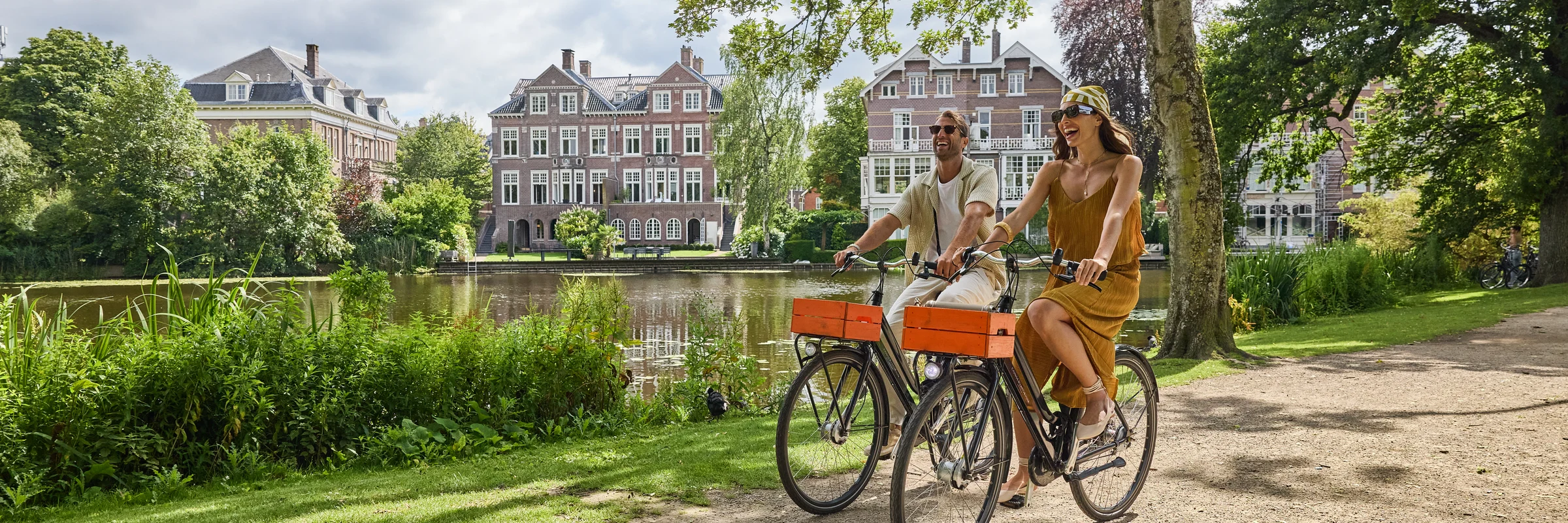
1. Amsterdam - Conservatorium Hotel

Walkable city, canals and design-led luxury. Meeting suites, private dining and enough culture to fill a two-night incentive.
- Group size: 30–150
- Best for: Creative incentives and client hosting
- Vibe: Stylish, compact, easy logistics
Ask about Conservatorium Hotel, Amsterdam
2. Dublin - The Shelbourne

Short flight, lively city and a landmark hotel on St Stephen’s Green. Good for awards, dinners and quick-hit incentives.
- Group size: 30–150
- Best for: Fast-turn rewards
- Vibe: Heritage, high-energy city
Ask about The Shelbourne, Dublin
3. Barcelona - Hotel Arts

Beachfront luxury with terraces, big function floors and easy access to old town restaurants. Sunshine helps the mood and the photos.
- Group size: 60–250
- Best for: Incentives with outdoor time
- Vibe: Coastal, modern, polished
Ask about Hotel Arts, Barcelona
4. Lisbon - EPIC SANA Lisboa

Strong value for five-star, rooftop pool and serious conference floors. Rooftop sundowners never hurt.
- Group size: 60–300
- Best for: Incentives with short sessions
- Vibe: Sunny, efficient, good food scene
5. Berlin - Hotel Adlon Kempinski

Prestige address beside the Brandenburg Gate. Classic rooms, crisp service and strong event suites.
- Group size: 40–180
- Best for: Leadership incentives
- Vibe: Grand, central, reliable
Ask about Hotel Adlon Kempinski, Berlin
6. Copenhagen - Villa Copenhagen

Old post office turned high-design hotel with a sustainability angle. Meeting kit is modern and the city sells itself.
- Group size: 30–180
- Best for: Design-led incentives
- Vibe: Nordic, clean, curated
7. Reykjavik - The Reykjavik EDITION

Modern waterfront base for northern-lights chases, Blue Lagoon runs and city dining. Good for winter wow without long haul.
- Group size: 30–120
- Best for: Cold-season incentives
- Vibe: Sleek, scenic, compact
Ask about The Reykjavik EDITION
8. Nice - Hyatt Regency Nice Palais de la Méditerranée

Promenade des Anglais views, terrace cocktails and quick transfers along the coast. Slick for C-suite hosting.
- Group size: 30–150
- Best for: Sunshine rewards
- Vibe: Riviera, classic, polished
Ask about Hyatt Regency Nice Palais de la Méditerranée
9. Rome - Rome Cavalieri, A Waldorf Astoria Hotel

Hilltop setting with city views, big function floors and a resort feel. Add Vatican or Colosseum access for impact.
- Group size: 60–250
- Best for: High-impact rewards
- Vibe: Grand, resort-style, cultural
10. Paris - Hôtel Lutetia

Left Bank icon with refined rooms and smooth service. Easy Eurostar or short flight keeps time on the ground high.
- Group size: 30–120
- Best for: Senior incentives
- Vibe: Elegant, central, Parisian
Ask about Hôtel Lutetia, Paris
Tell us weekends vs weekdays, and how much meeting time you need. We’ll balance flights, transfers and late checkout in one plan.
The Most Environmentally Friendly Venues in the UK
The Most Environmentally Friendly Venues in the UK
Budgets still matter, but so does proof. These venues pair credible sustainability with access, good tech and steady service. You get data for reporting and a space that feels right.
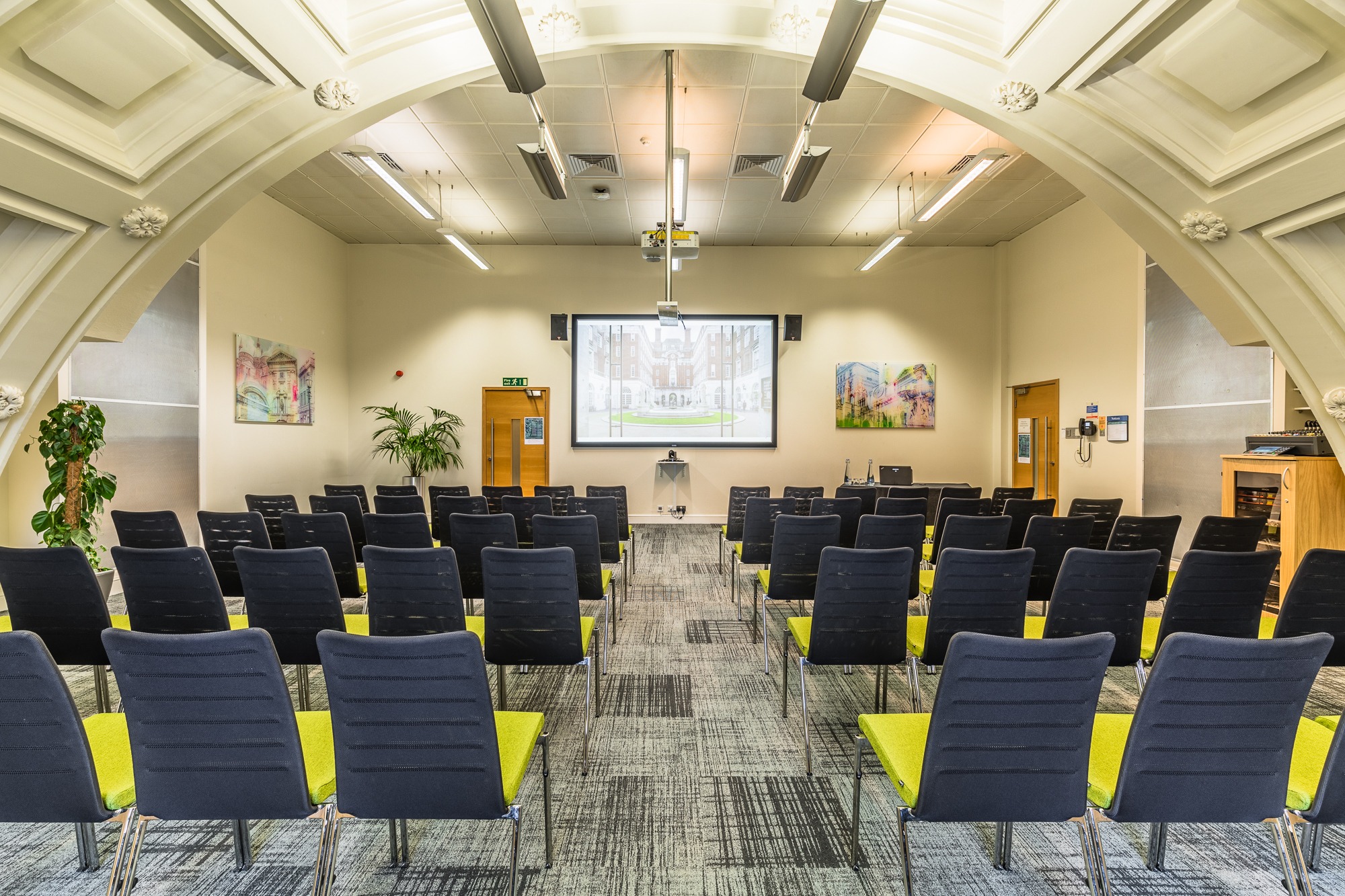
1. BMA House, London
 Historic Bloomsbury venue with strong sustainability practices and gardens for fresh-air breaks. Reliable for conferences and awards.
- Capacity: Multi-room conferences
- Best for: Day conferences with receptions
- Vibe: Heritage, practical, green-focused
2. Barbican Centre, London

City cultural icon with a deep sustainability programme, strong transport links and theatres that look and sound the part.
- Capacity: Theatres, halls and rooms
- Best for: Conferences and creative showcases
- Vibe: Architectural, central, credible
Ask about Barbican Centre, London
3. Royal Lancaster London

Park-side hotel with visible green initiatives and event spaces that scale from training rooms to major awards.
- Capacity: From suites to large ballrooms
- Best for: Awards, conferences, dinners
- Vibe: Professional, proactive, central-west
Ask about Royal Lancaster London
4. EICC, Edinburgh

Modern venue with energy and waste programmes built into day-to-day operations. Easy for large conferences to make credible gains.
- Capacity: Major plenary and breakouts
- Best for: Conferences with reporting needs
- Vibe: Data-friendly, central, polished
5. SEC Glasgow

Riverside campus with large halls and strong credentials on energy and food sourcing. Hotels on and near site keep travel short.
- Capacity: Halls and theatres for thousands
- Best for: Large congress and expo
- Vibe: Scalable, accessible, measurable
6. ACC Liverpool

Waterfront venue with integrated arena, convention and exhibition centres. Sustainability is not an afterthought here.
- Capacity: Arena, conference and expo
- Best for: Multi-day conferences with exhibition
- Vibe: Modern, walkable, well-drilled
7. ExCeL London

Docklands venue with efficient transport links and programmes focused on energy, materials and water. Big shows run smoothly here.
- Capacity: Major exhibitions and congress
- Best for: Scale with data-backed reporting
- Vibe: Operational, modern, proven
8. Eden Project, Cornwall

Biomes and education at the core. Your message lands better when the setting lives it daily.
- Capacity: Theatre and reception formats
- Best for: Purpose-led conferences
- Vibe: Experiential, green-first
Ask about Eden Project, Cornwall
9. Royal Botanic Gardens, Kew

Living collections, glasshouses and listed buildings. Green travel options and clear supplier standards support honest reporting.
- Capacity: Dinners, receptions and meetings
- Best for: Brand stories tied to nature
- Vibe: Natural, elegant, London-accessible
Ask about Royal Botanic Gardens, Kew
10. Friends House, London

Quaker meeting venue with transparent policies on energy, waste and sourcing. Close to Euston, which helps cut travel emissions.
- Capacity: Auditorium and breakouts
- Best for: Conferences with strict reporting
- Vibe: Practical, values-led, central
Ask about Friends House, London
Ask us to include carbon estimates, supplier standards and travel alternatives in every proposal. We’ll build it in from the start.
Manchester’s Best Private Bars and Dining Rooms
Manchester’s Best Private Bars and Dining Rooms
Manchester does private rooms well. Strong kitchens, proper privacy and city views where you want them. These picks cover client dinners, team wins and late-night celebrations.
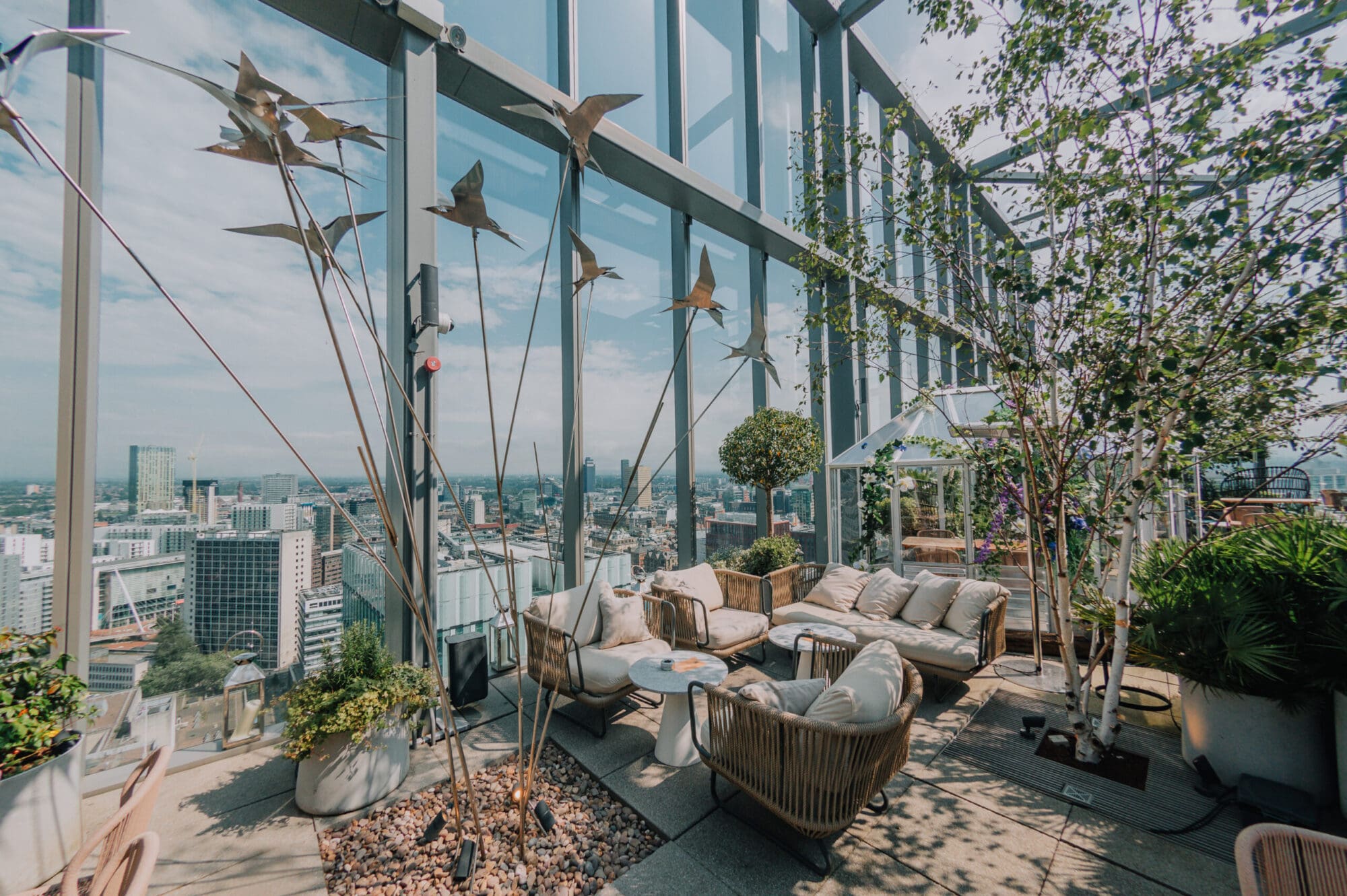
1. 20 Stories - Private Dining Room

Skyline views from Spinningfields with a private room that feels special even before the food lands. Terrace access for a quick toast when the weather behaves.
- Capacity: Mid-size private dining
- Best for: Client dinners with a view
- Vibe: Polished, modern, city skyline
Ask about 20 Stories Private Dining Room
2. The Ivy Spinningfields - The Dalton Room

Vibrant styling and dependable service. Easy to brand lightly with menus or a short welcome speech before dinner.
- Capacity: Small to mid-size private dining
- Best for: Celebrations and client hosting
- Vibe: Glam, buzzy, central
Ask about The Ivy Spinningfields - The Dalton Room
3. Hawksmoor Manchester - Private Dining

Confident kitchen, excellent service and a private room that keeps sound levels civilised. Good for straight-talking business dinners.
- Capacity: 10–30
- Best for: No-fuss, high quality dining
- Vibe: Warm, grown-up, classic
Ask about Hawksmoor Manchester Private Dining
4. The Refuge - Private Dining Room

Inside the Kimpton Clocktower with that famous Winter Garden next door. The private room feels clubby without being dark.
- Capacity: 12–24
- Best for: Team wins and client socials
- Vibe: Grand building, modern menu
Ask about The Refuge Private Dining Room
5. Dakota Manchester - Private Dining Suite

Low lighting, sharp service and a space that feels properly private. Handy when you want the dinner to be the main event.
- Capacity: 10–20
- Best for: Executive dining
- Vibe: Discreet, contemporary, smart
Ask about Dakota Manchester Private Dining Suite
6. Stock Exchange Hotel - The Vault

Character space in the former trading hall building. Great talking point, well handled by a switched-on team.
- Capacity: 10–14
- Best for: Intimate client dinners
- Vibe: Historic, boutique luxury
Ask about Stock Exchange Hotel - The Vault
7. Manchester Hall - The Goulburn Suite

Renovated Freemasons’ Hall with wood-panelled drama and good catering. Easy to brand lightly for sponsors or internal events.
- Capacity: 20–60
- Best for: Presentations followed by dinner
- Vibe: Heritage, versatile, central
Ask about Manchester Hall - The Goulburn Suite
8. Tattu Manchester - Private Dining

Dimly lit, striking interiors and a menu that feels celebratory. Good when you want memorability without formal speeches.
- Capacity: 10–24
- Best for: Reward dinners
- Vibe: Stylised, buzz, late-night friendly
Ask about Tattu Manchester Private Dining
9. King Street Townhouse - Wine Cellar & Small Rooms

Chic townhouse hotel with snug private spaces and a rooftop pool for next-day downtime if you stay over.
- Capacity: 8–20
- Best for: Quiet negotiations and hosted tastings
- Vibe: Boutique, cosy, central
Ask about King Street Townhouse Private Dining
10. The Midland - Mount Street PDR

Classic hotel with a refreshed dining scene. The private room feels grown-up and the kitchen is consistent.
- Capacity: 10–24
- Best for: Business dining with polish
- Vibe: Traditional hotel, modern plates
Ask about The Midland - Mount Street PDR
Tell us the budget and what you want the room to say about you. We’ll match food, privacy and after-dinner options on one sheet.
The Most Unique Boardrooms in London
The Most Unique Boardrooms in London
Private, impressive and practical. These rooms lift the tone of any senior meeting without feeling stuffy.
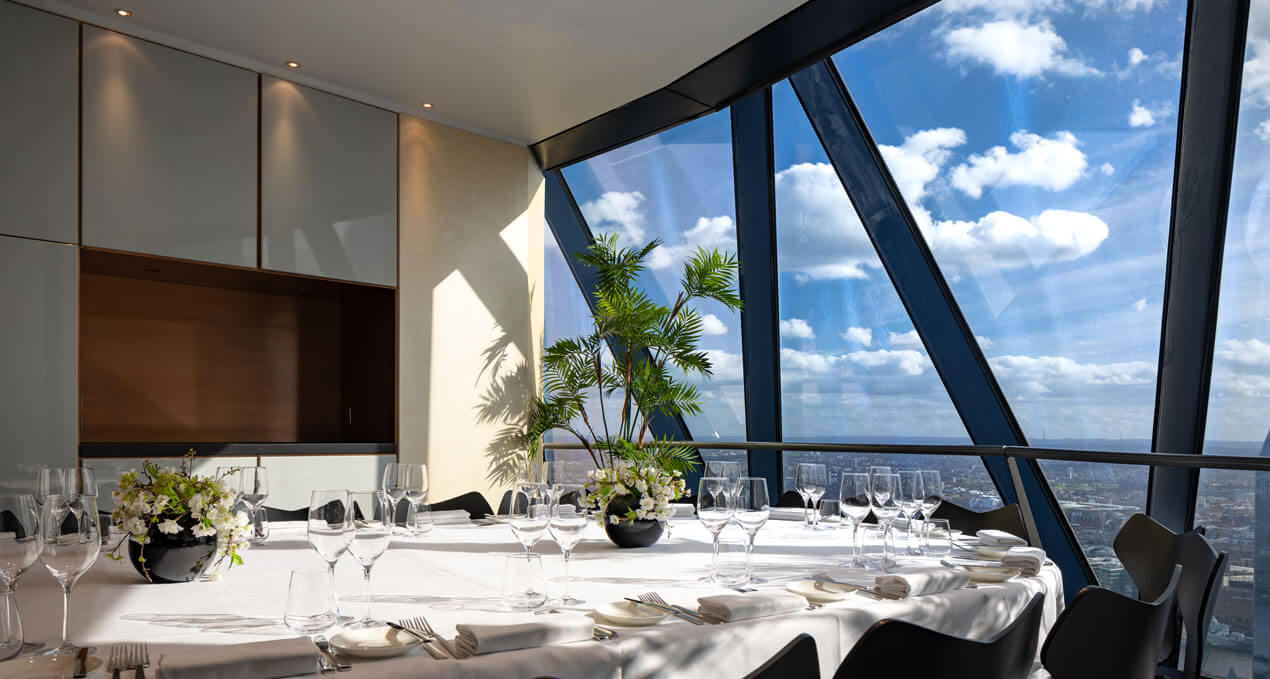
1. Private Dining Rooms, Searcys at The Gherkin

Skyline backdrop with circular architecture that actually helps conversation. Great service and AV add-ons available.
- Capacity: 10–30
- Best for: Board sessions with dinner
- Vibe: Iconic, high-rise
Ask about Searcys at The Gherkin Private Rooms
2. Shangri-La at The Shard - Meeting Suites
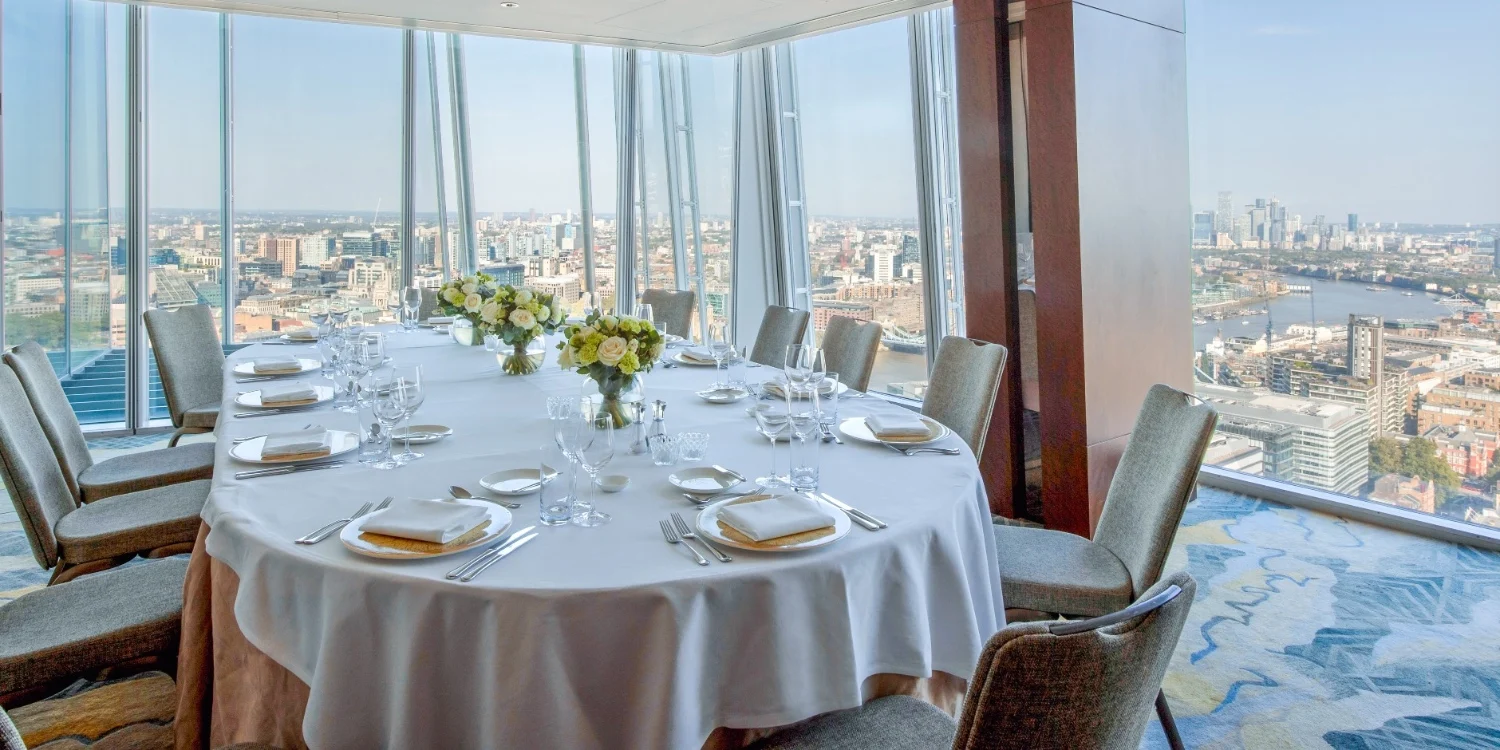 Clean, modern rooms with serious views. Works for strategy sessions that roll into private dining.
- Capacity: 8–20
- Best for: Executive planning
- Vibe: Minimal, sky-high
Ask about Shangri-La at The Shard - Meeting Suites
3. The Wren Room, The Ned
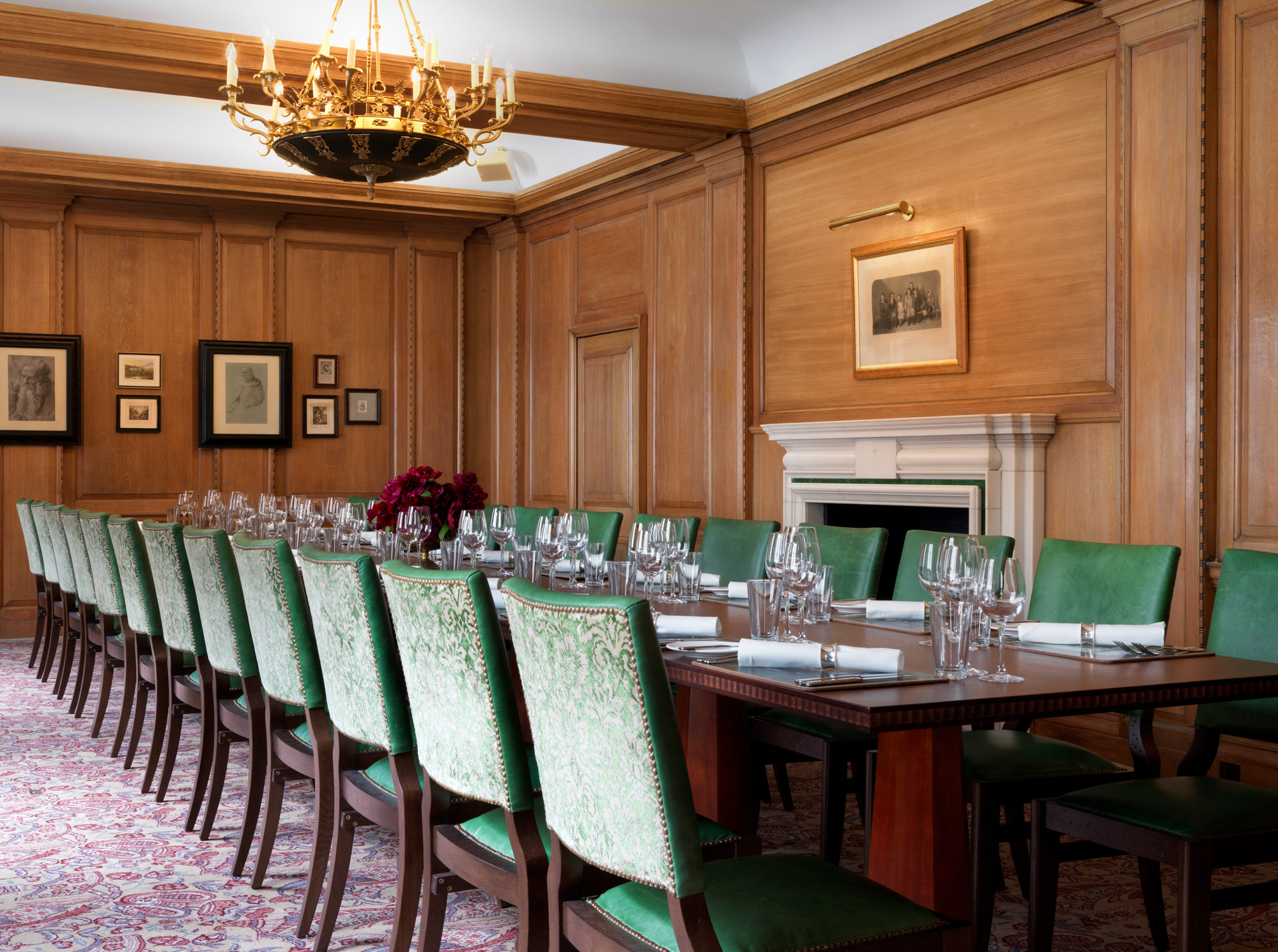 Paneled walls, high ceilings and a proper sense of occasion. A short walk to multiple breakout options in the building.
- Capacity: 10–22
- Best for: Investor or client pitches
- Vibe: Heritage, City-smart
Ask about The Wren Room, The Ned
4. The Boardroom, Rosewood London
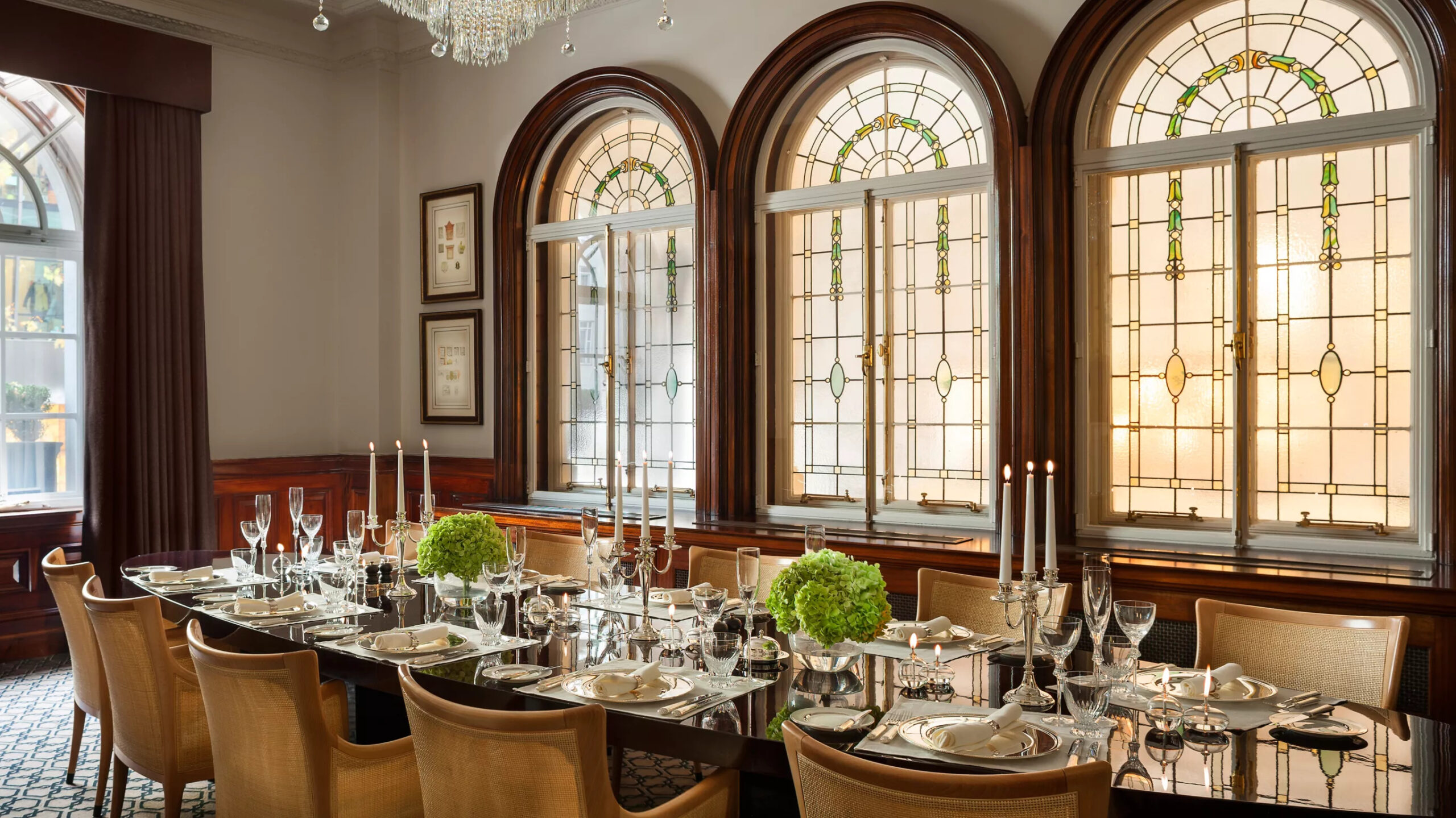 Handsome, residential feel with attentive service. Quiet, well-insulated and set up for hybrid if you need it.
- Capacity: 10–20
- Best for: Senior leadership meetings
- Vibe: Elegant, discreet
Ask about The Boardroom, Rosewood London
5. The Boardroom, The Langham London
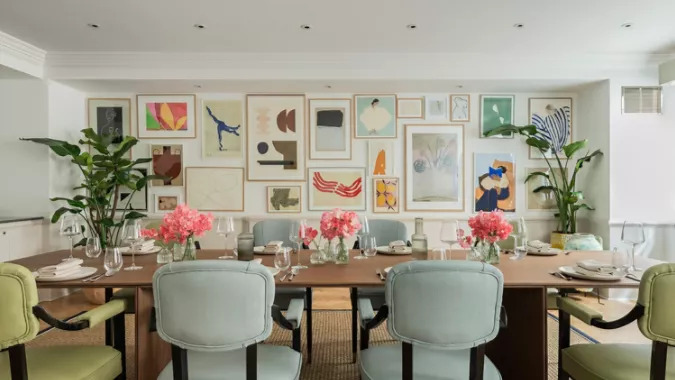
Bright, traditional setting with strong service and a short lift ride to excellent dining.
- Capacity: 10–18
- Best for: Partner councils
- Vibe: Classic, calm
Ask about The Boardroom, The Langham London
6. The Council Room, The Royal Society
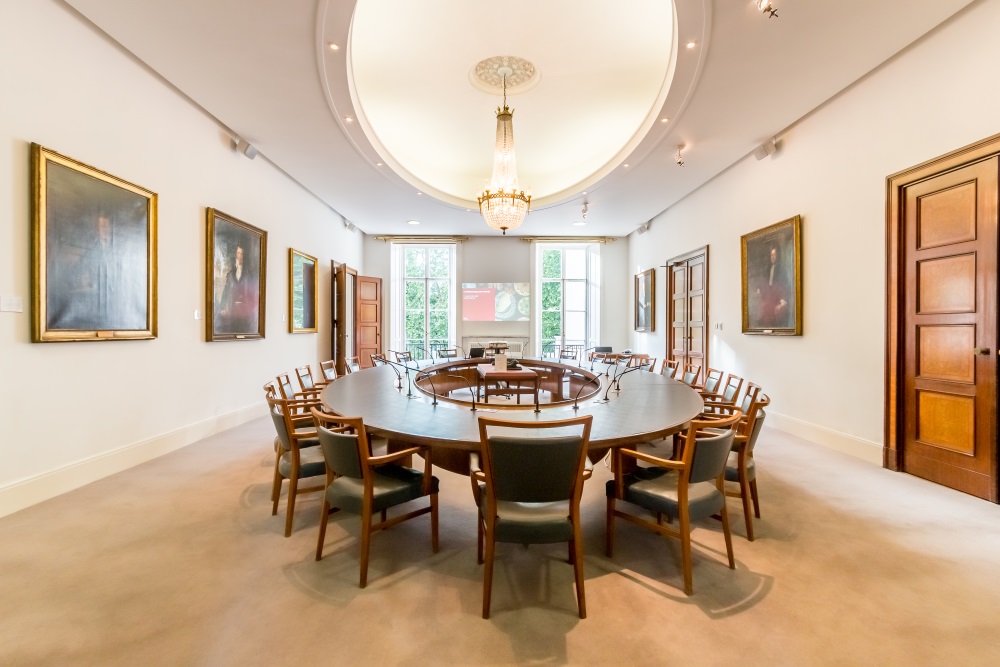
Academic gravitas with modern AV. Perfect for sessions where credibility matters.
- Capacity: 16–28
- Best for: Advisory boards
- Vibe: Learned, authoritative
Ask about Council Room, The Royal Society
7. Navy Board Rooms, Somerset House
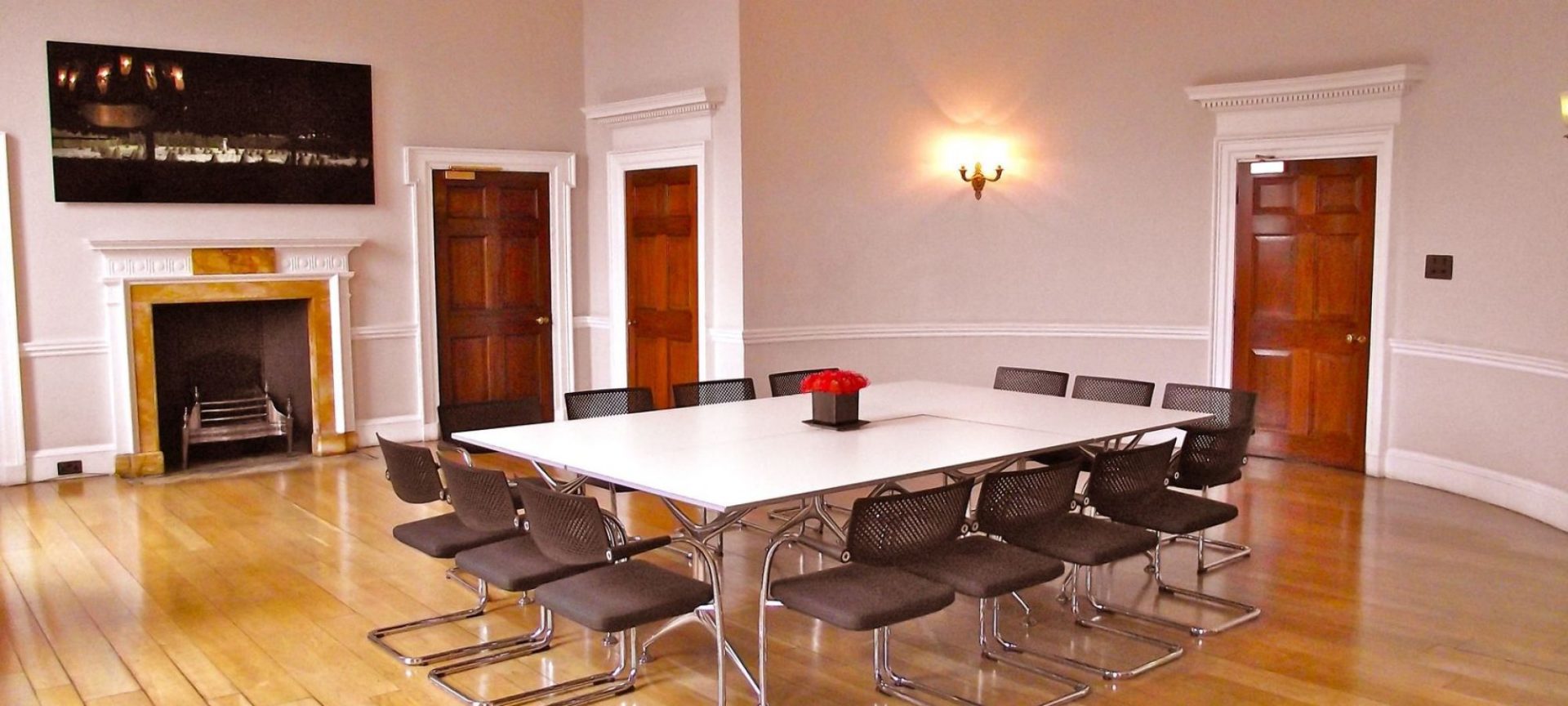 Historic rooms with river views and lots of daylight. Good acoustics and privacy.
- Capacity: 12–30
- Best for: Strategy days, client councils
- Vibe: Period elegance, calm
Ask about Navy Board Rooms, Somerset House
8. 30 Euston Square - Heritage Rooms
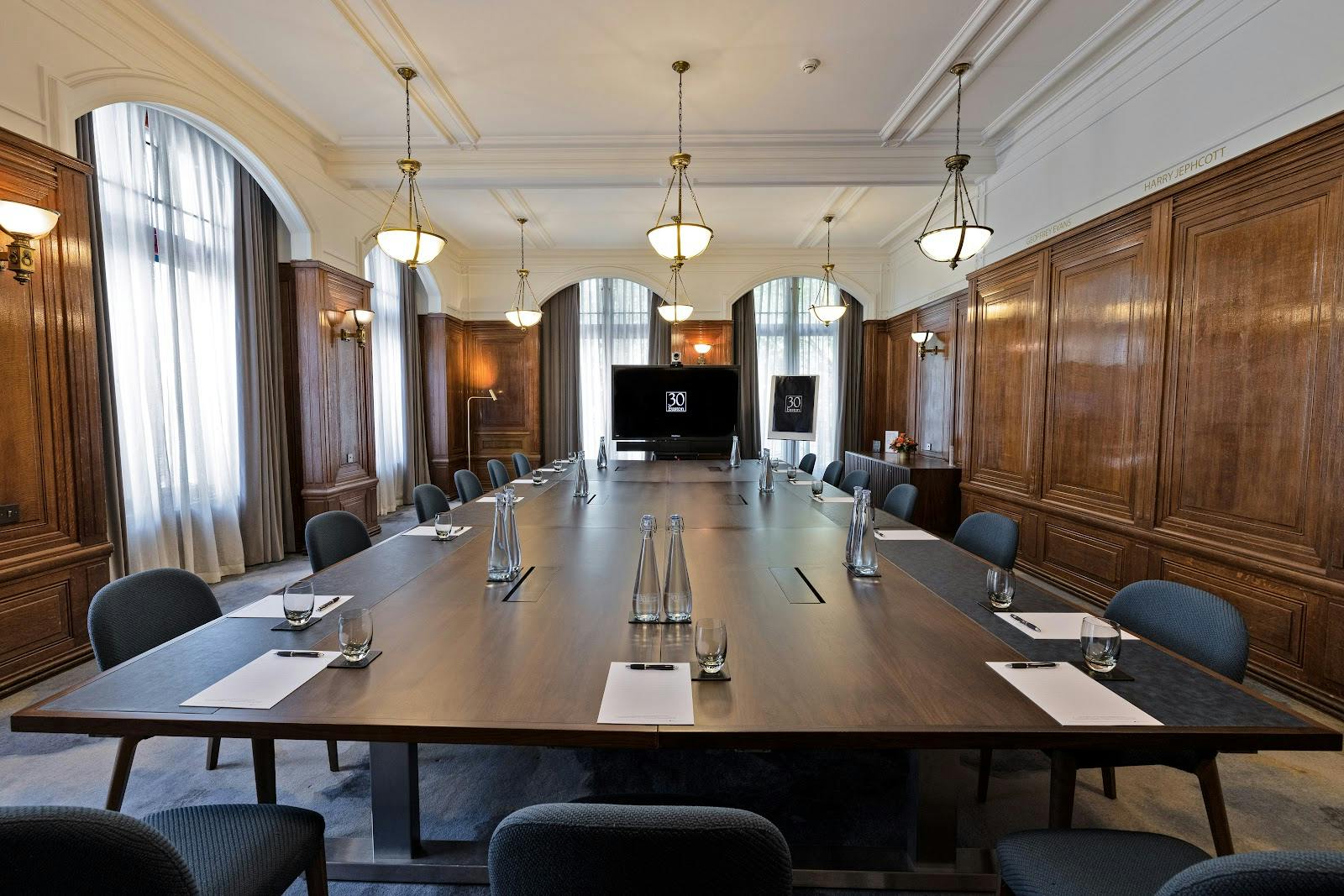 Period boardrooms with private dining and modern AV a short walk from Euston and King’s Cross.
- Capacity: 8–20
- Best for: Rail-friendly executive sessions
- Vibe: Heritage, professional
Ask about 30 Euston Square Heritage Rooms
9. The Boardroom, Corinthia London
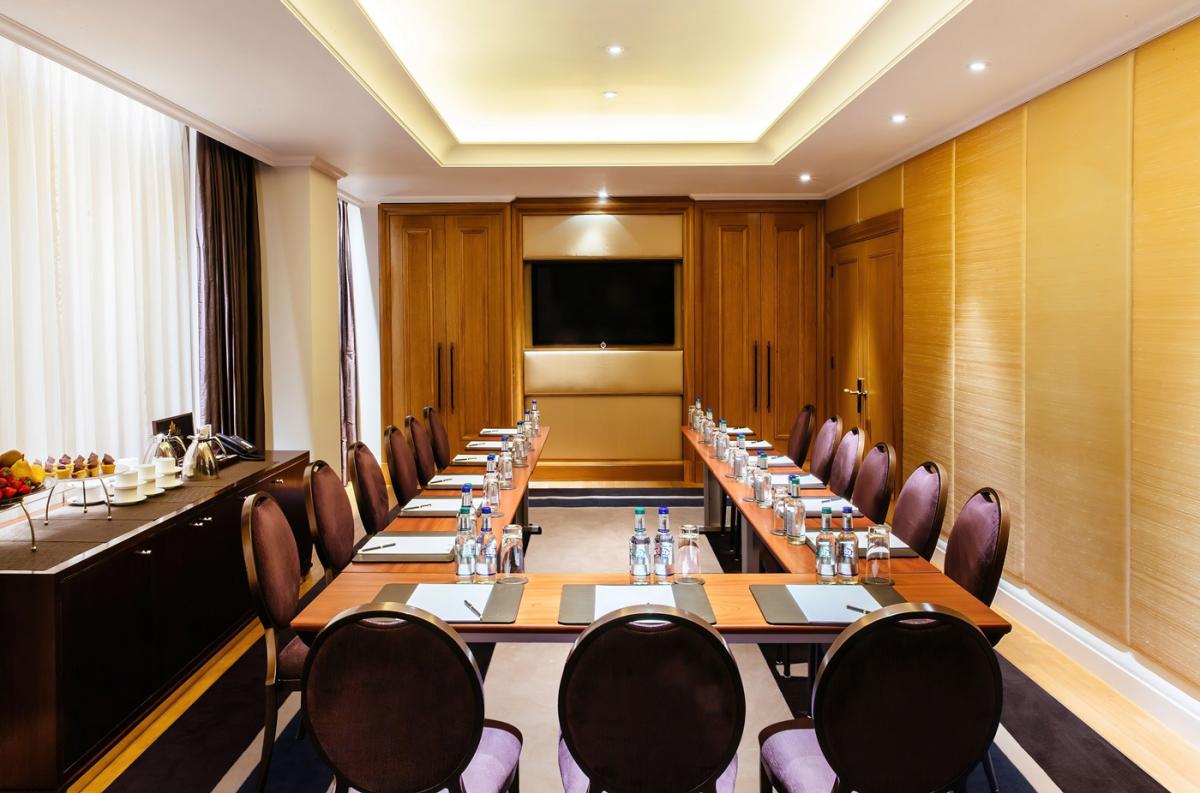 High-spec detailing and a service team that gets senior expectations. Easy step-up to private dining.
- Capacity: 10–18
- Best for: High-stakes meetings
- Vibe: Luxurious, composed
Ask about The Boardroom, Corinthia London
10. Private Room, One Aldwych
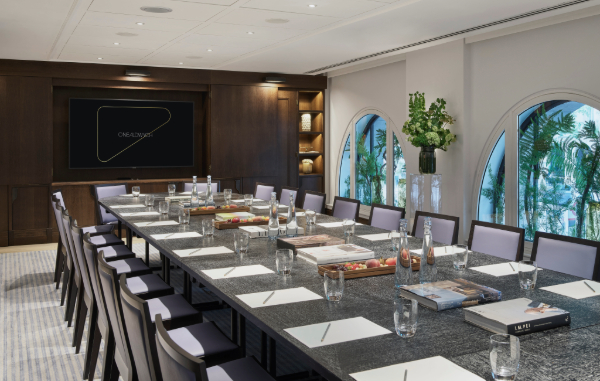
Modern, central and quietly stylish. Works for confidential sessions with premium touches.
- Capacity: 8–16
- Best for: Board and client councils
- Vibe: Contemporary, discreet
Ask about Private Room, One Aldwych
Need NDA handling and secure catering flow? We’ll set it up with the venue.